Entwined Homeland, Empowered Diasporas: Aviad Moreno's Study of Moroccan Jewish Diaspora
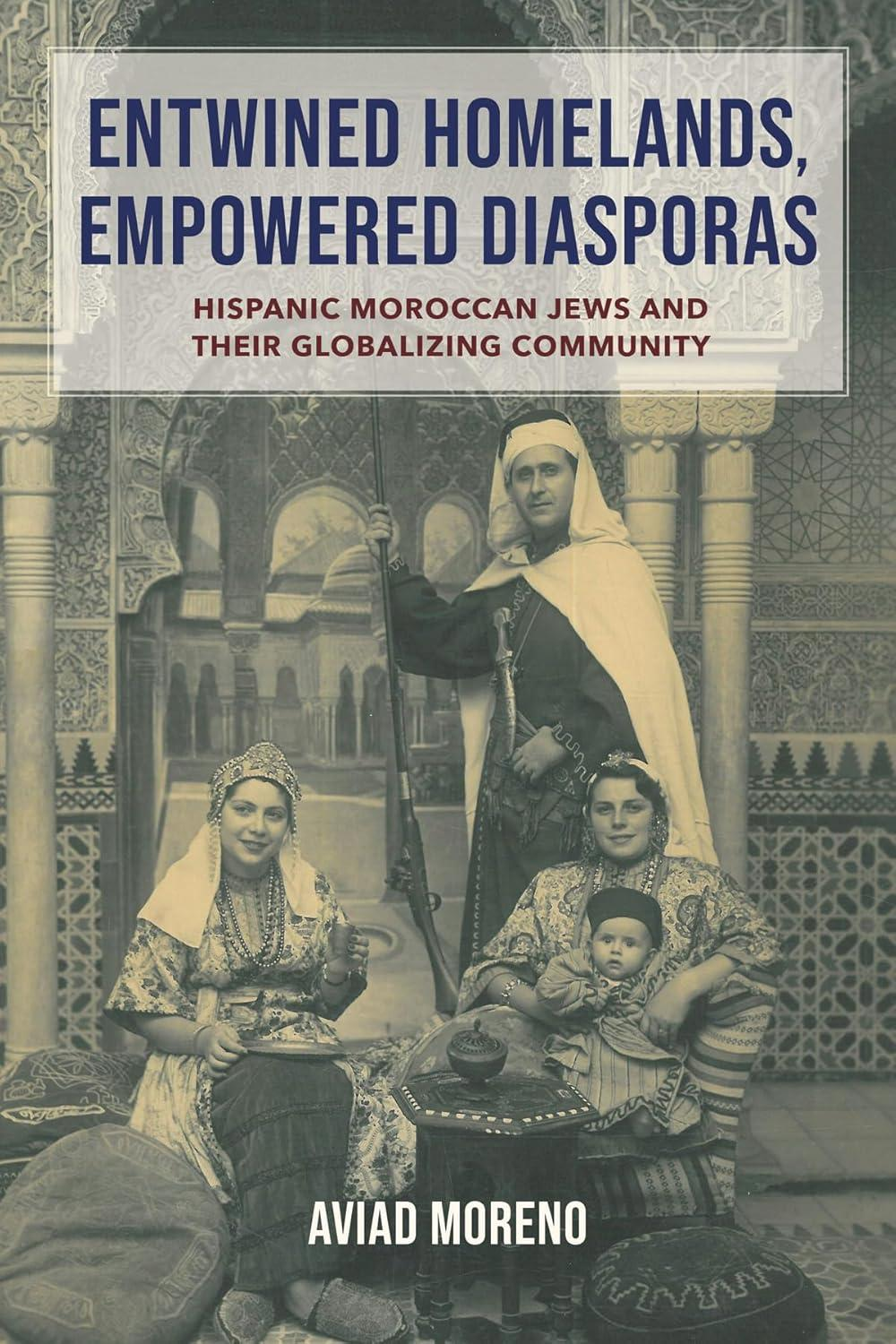
A lecture by Mati Shemoelof on Aviad Moreno's Entwined Homeland, Empowered Diasporas: Hispanic Moroccan Jews and Their Globalizing Community (Indiana University Press, 2024).
Aviad Moreno's book presents a study of the Jews of northern Morocco and their migrations across three continents from the nineteenth to the twenty-first century. Moreno examines how diaspora communities are formed not simply through a shared place of origin, but through collective narratives, institutions, networks and ongoing cultural practices.
The book's transnational perspective follows the Jewish communities of northern Morocco across Morocco, Spain, Israel, South America and other locations. It explores the preservation and transformation of Jewish-Spanish identity, the role of Haketia, colonialism, migration and the ways in which communal narratives travel between places and generations.
In this lecture, Mati Shemoelof discusses Moreno's approach to diaspora, the Spanish connection of northern Moroccan Jews, the relationship between Jewish and Spanish identities, colonial Morocco, and the migration of Moroccan Jews to South America and Israel.
The lecture also considers the idea of multiple homelands and the ways in which identity can continue to develop across different places rather than being understood exclusively through a single national homeland.
*
Aviad Moreno's book, Entwined Homeland, Empowered Diasporas: Hispanic Moroccan Jews and Their Globalizing Community (Indiana University Press, 2024), presents a groundbreaking study on the Jews of northern Morocco and their migrations across three continents from the 19th to the 21st century. Moreno argues that being from a specific place is insufficient to become part of a diaspora; one must also act with awareness, embrace the collective narrative, and disseminate it through networks and institutions.
A key innovation is his exploration of the transnational nature of the community narrative, which synchronously and diachronically develops worldwide, weaving a cross-continental story that travels between places.
"As many diaspora scholars have argued in recent years regarding the social structure of diasporas, diaspora formation and maintenance require a significant number of scattered individuals who adhere to the diaspora idea, even situationally, as the construct develops over time. In other words, it is not enough to merely be from a specific place of origin to become a member of a diaspora – you also need to act on that awareness to become a member, to accept the collective narrative and often further disseminate it through networks and institutions. Or, as Diaspora scholar Brian Keith Axel inquires, "Who in the most quotidian of ways, claims to be the subject of diaspora?...what are the everyday conditions for the identification of a subject of diaspora" (page 14)
Moreno analyzes ethnographic publications and the institutions that produced and distributed them as sites of community formation: examining sources like personal and communal correspondence, community journalism that was never before researched - over 150 interviews spanning decades, and radio programs from Morocco, France, Canada, Venezuela, Spain, Israel, Portugal, and Switzerland.
In addition, despite the preoccupation of Jewish studies with the concepts of diasporas and exile, when it comes to MENA Jewish diasporas, much of the scholarship ends in the midtwentieth century, just prior to the "great rupture" that is said to have separated Jews from their pre-migration environment during and in the aftermath of colonialism. Moreno abandons the Israeli national perception as an exclusive framework.
Moreno's work delves into the affinity for the Spanish connection preserved across generations in various ways like the Haketia -Judeo Spanish dialect—Developed in northern Morocco immediately after the expulsion, Haketia was an amalgam of Arabic and Tamazight dialects that were added to it after the settlement of Jews in northern Morocco in the fifteen centuries. Haketia marked the centuries long attachment of Jews in Northern Morocco to Spain, even when that country that expelled them continued to officially reject their right to for a new community in its mainland territory well into the twentieth century.
This preserved culture found new, unprecedented dialogue with Spanish colonizers in Morocco, some of whom viewed the Sephardic Jews as "lost brothers." Moreno also addresses an under-researched century-long migration of northern Moroccan Jews to South America and Spain, alongside migration to Israel. He details how the Jewish-Spanish identity of Moroccan Jews adapted to new contexts, transferring between places and providing them with unique resources.
The book's premise diverges from a purely national perspective, emphasizing instead a syncretic view of cultural transformations across diverse times and places. Moreno examines Jewish-Spanish identity in the Arab world amidst Spanish and French colonialism in Morocco, noting that while the Spanish occupation began in 1859, only in 1912 did colonial powers divide Morocco, into two protectorates- initiating a "re-Hispanicization." Tetouan became the Spanish Protectorate's capital, and Tangier, an international city, sheltered Spanish Republicans fleeing Franco's regime and Jews fleeing Nazi Germany. In a survey conducted in 1955, there were 150,000 inhabitants in Tangier, of which 60,000 were Europeans, 75,000 Muslims and 14,000 Jews. It was an ultimate space for reshaping a communal past consciousness.
During Spanish rule, Moroccan Muslims often saw Spanish as a foreign language used to navigate bureaucracy and to deal with various financial and public institutions. For instance, data from the Biblioteca Publica Española in Tangier reveals that, in 1946, only 1,931 Muslims registered at the library compared to 3,491 Jews, suggesting that while Muslims were the dominant religious group in Tangier, few identified Spanish as central to their ethno-religious identity. Moreno cites a report written in 1903 by the AIU / Alliance Isralite Universelle on the Jews of Tangier, from which it appears that the Haketia was used as an ethnic spoken language among over two-thirds of the entire community. The historian Maite Ojeda Mata teaches us that in 1914, in the homes of approximately eighty percent of the Jews in Tetouan, Spanish was used as the main language, in contrast to the massive use of Arabic among the 12,000 Muslims who lived in the city.
For the Jews, Spanish colonialism represented a "return" to Spain, empowering their Jewish-Spanish identity through cultural shifts like modern Spanish publications, music, soccer, bullfighting, and a connection to South American culture. It was a generational change. Young Jewish people increasingly embraced this new culture, sometimes straying from their parents' traditions, such as eating non-kosher food or attending school on the Sabbath and a romantic relationship with non-Jews. Within this context, some sought to strengthen Jewish ties to Spain, occasionally supported by the colonial government itself.
Moreno's work illuminates Franco's double standards toward Jews: while pre-Holocaust antisemitism led Franco to blame Jews for Spain's decline, he simultaneously distinguished Sephardic from Ashkenazi Jews, rationalizing colonial control of Moroccan Jewish communities. His military regime's victory in northern Morocco in 1936 fueled a pro-Spanish narrative that interwove Moroccan history with Andalusian roots. Institutions like the Hispano-Arab Research Institute and publications such as España promoted this Jewish-Spanish connection.
It is fascinating to read about the double standards that Franco's regime adopted towards the Jews. Amid the anti-semitic winds blowing from Eastern Europe in the pre-Holocaust years, anti-Semitic expression in Spain took the form of accusations that Jews sought to stir disorder. France and his nationalist supporters railed against the so-called Jewish-Bolshevik-Masonic conspiracy, blaming world Jewry for Spain's deterioration into civil war. Franco's anti-Jewish expressions contradicted his regime's declared commitment to Philo-Sephardi objectives and revealed how cynical his discourse was. In franco's mind a cultural separation between Sephardim and Ashkenazim became essential for colonizing the Jewish communities of Morocco. With the victory of Franco's nationalist military regime in northern Morocco in July 1936, the Andalus centric narrative of Moroccan history became entwined with Philo Sephardim, fueling the emergence of new local institution that helped further disseminate the idea with Franco's support. The founding in 1938 if the general Franco institute of Hispno Arab research was a landmark event In that regard. The institute published dozens of works emphasizing the historical and cultural connections between Al-Andalus, Morocco, and Francoist Spain. Moreover, some community leaders and members of the Jewish intellectual and economic elites continued to support the Philo Sephardi philosophy even when it imbued with strong fascist spirtis.
On April 7, 1956 the Spanish protectorate ended and before that in the same year the French protectorate came to an end. Even after the independence of Morocco and the immigration to Israel or South America and other countries, the Jews in Morocco and abroad continued to consume and create a discourse that connected them to Spain, a discourse that they interwoven as Jewish immigrant communities with additional ties to Morocco and Israel.
One of the most interesting chapters explores northern Moroccan Jews' migration to select South American countries, such as Venezuela, where Spanish language knowledge facilitated integration. This immigration started as early as the beginning of the 19th century and the role of colonial Spanish regime is revealed again, in Venezuela, for example, Spain granting citizenship to those Jews. Jews maintained distinct identities from Ashkenazi and Ladino-speaking Jews, establishing synagogues, organizations, and communities. Yet, with the economic crisis before WWI, many returned to Morocco. This return migration formed a trans-Atlantic migrant network, which Moreno explores to offer new perspectives on the backflow's impact on Moroccan Jewish communities.
Moreno's innovative study provides a foundation for further research into identity, recognizing that it cannot be solely understood through the lens of a singular homeland but through a perception of multiple homelands.
This lecture about Aviad Moreno's book was delivered at the conference "In the Name of the Father? Writing Jewish Masculinities across the Middle East and North Africa," held at the University of Venice from October 27 to 29, 2024.
*
Book: Aviad Moreno, Entwined Homeland, Empowered Diasporas: Hispanic Moroccan Jews and Their Globalizing Community, Indiana University Press, 2024.
Lecture delivered at: “In the Name of the Father? Writing Jewish Masculinities across the Middle East and North Africa,” University of Venice, 27–29 October 2024.
Category: Articles and Essays
Tags: Mati Shemoelof, Aviad Moreno, Entwined Homeland Empowered Diasporas, Moroccan Jews, Moroccan Jewish Diaspora, Hispanic Moroccan Jews, Haketia, Sephardic Jews, Jewish Diaspora, Mizrahi Jews, Jewish History, Morocco, Spain, Israel, South America, Migration, Diaspora Studies, MENA Jews, Jewish Masculinities, University of Venice