The MIDDLE EAST UNION Festival
The MIDDLE EAST UNION Festival
A Multilingual Literary and Cultural Festival in Berlin
The MIDDLE EAST UNION Festival was a four-day literary and cultural festival in Berlin, curated by Mati Shemoelof, Hila Amit and Alaa Obeid. Taking place from 12–15 August 2021, the festival brought together more than 40 writers, poets, artists, musicians, researchers and activists from the Middle East and its diasporas. The festival received a full grant from the Berlin Senate for Culture and Social Cohesion in recognition of its artistic and cultural significance.
Through literature, poetry, music, film, performance and discussion, the festival explored a radical and deliberately utopian question: What could a Middle East Union look like?
Rather than proposing a political programme or institutional model, the festival used culture and artistic imagination to explore what might become possible beyond national borders, political conflicts, religious divisions and inherited categories.
Imagining a Middle East Union
The idea of the Middle East Union was inspired partly by the history of the European Union: countries divided by war and conflict created a framework for political, economic and social cooperation.
The festival asked whether a similar idea could be imagined for the Middle East and North Africa.
What would happen if borders could become more open? What could connect people whose families, languages and cultures have been divided by modern nation-states? Could a shared regional framework create new possibilities for cultural exchange, human rights, cooperation and solidarity?
The festival approached these questions as a utopian exercise. It did not claim to have the answers. Instead, it created a space in which artists, writers and thinkers could imagine alternatives together.
As curator Mati Shemoelof explained at the time, the festival was an attempt to plant a seed: to imagine that another form of coexistence might be possible.
Berlin as a Middle Eastern Diaspora City
Berlin was central to the concept of the festival.
For the curators, Berlin was not simply a location outside the Middle East. It was a meeting point for different Middle Eastern diasporas and a place where people who could not easily meet in their countries of origin could encounter one another.
The festival grew out of the experience of living in Berlin as migrants and members of Middle Eastern diasporas. Arabic, Hebrew, German, Persian and other languages could exist alongside one another, while Jewish, Arab, Palestinian, Israeli, Iranian and other identities could meet outside the political structures that often keep them apart.
This perspective was reflected in the festival's multilingual programme and in its decision to centre artists, writers, researchers and activists with direct cultural, biographical or intellectual connections to the region.
The festival also challenged the familiar European framework through which the Middle East is often discussed. Rather than inviting predominantly German or European commentators to explain the region, it created space for people from the region and its diasporas to speak for themselves.
From Arab-Jewish Cultural Work to the Middle East Union
The MIDDLE EAST UNION Festival was part of a longer curatorial process developed by Mati Shemoelof and his collaborators in Berlin.
It grew out of the earlier project ANU: Jews and Arabs Writing in Berlin, founded by Mati Shemoelof and Hila Amit. ANU brought Jewish and Arab writers and artists together for readings, discussions and cultural events, creating a space for literary and cultural exchange within the Middle Eastern diaspora in Berlin.
The work developed further through PARATAXE Symposium VII: NahostBerlin – the literary Middle East Union, which explored Jewish and Arab, Berlin and Middle Eastern literary cultures.
The 2021 festival became a larger continuation of this work: an attempt to move from literary dialogue toward a broader cultural and political imagination of the region.
A Multilingual and Interdisciplinary Programme
The festival programme was deliberately multilingual, taking place in German, English, Arabic and Hebrew.
It brought together literature, poetry, translation, music, film, performance, environmental activism, feminist perspectives and queer thought.
Among the programme's central events were:
Writing the Arab-Jew: Reflections on Displacement and Middle Eastern Diasporas
Literary Vision: Bi-national Literature and Translation as Middle East Union Culture
Arab-Jewish Musical Traditions: Religious Secrets from Past and Future
After Censorship: We Gain Creativity – Middle East Union Values and Language
Queeristan, exploring queer perspectives from the Middle East
Women Create Change
Discussions on climate, migration, censorship and cultural identity
Literary readings, film screenings, performances and concerts
The festival opened at BABYLON Berlin with a proclamation of a Middle Eastern Union, a discussion and a concert by the Berlin-based Iranian-Israeli group Sistanagila.
Other events brought together Jewish, Arab, Palestinian, Israeli, Iranian and other perspectives through literature, music, film and performance.
Jewish-Arab Cultural Memory
One of the festival's central ideas was that Jewish and Arab histories should not automatically be understood as opposing histories.
The curatorial work drew attention to the history of Jews from Arab and Middle Eastern countries and to the cultural connections between Jewish and Arab communities.
The festival created space for Mizrahi and Arab-Jewish histories, languages and musical traditions that are often marginalised within European Jewish narratives and dominant Israeli narratives.
This approach was visible in the musical programme, including Arab-Jewish liturgical poetry, Middle Eastern musical traditions and collaborations between Jewish and Arab musicians.
Queer, Feminist and Environmental Perspectives
The idea of a Middle East Union was not limited to questions of national borders.
The festival also asked what a future regional society might look like for people whose voices are often marginalised within national and political frameworks.
Queer participants explored alternative forms of family, community and belonging. Feminist discussions addressed women's participation in cultural and political life. Environmental activists considered cooperation across borders in response to the climate crisis.
In this sense, the festival imagined a Middle East Union not simply as a union of states, but as a possible framework for people, communities and cultures.
The Festival and the European Union
Living as migrants within the European Union was one of the starting points for the festival's central question.
The European Union offered a historical example of countries that had experienced devastating conflicts and later created mechanisms for cooperation and shared institutions.
At the same time, the festival did not present the EU as a perfect model. It asked what could be learned from European integration, but also what its failures, exclusions and contradictions might teach a future Middle Eastern project.
The question was therefore not simply:
Could the Middle East become like Europe?
It was:
What could a future regional union learn from Europe — and what could it imagine differently?
A Festival as a Political and Artistic Experiment
The MIDDLE EAST UNION Festival did not claim that poetry, music or literature could immediately solve the political conflicts of the Middle East.
Instead, it proposed something smaller and, at the same time, more ambitious: the right to imagine another political reality.
For four days in Berlin, people whose histories, languages, passports and political identities often place them on opposite sides of borders came together to discuss literature, music, translation, migration, sexuality, climate, memory and political possibility.
The festival treated artistic practice as a form of political imagination — a way of creating encounters before political structures make those encounters possible.
In this sense, the MIDDLE EAST UNION existed simultaneously as a literary festival, a cultural project, a curatorial experiment and a speculative political imagination.
Recognition and Support
The MIDDLE EAST UNION Festival was supported through Berlin's cultural funding structures and received support from the Hauptstadtkulturfonds.
For Mati Shemoelof, the festival represented a significant stage in his development as a curator of multilingual, diasporic and cross-cultural literary projects in Berlin.
It brought together ideas that had developed through his earlier work with ANU and other literary and cultural initiatives and expanded them into a four-day international festival.
Media and Public Response
The festival attracted attention from German, European and international media.
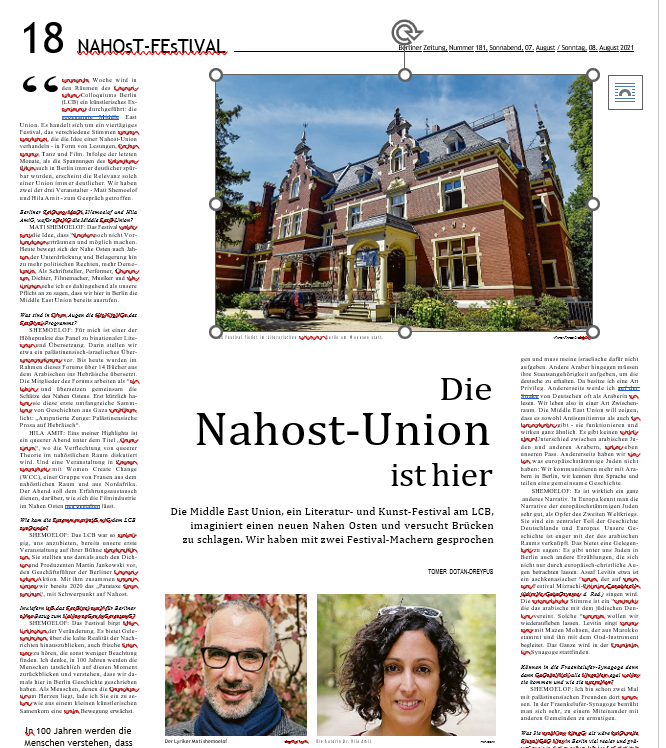
Coverage and interviews appeared in taz, der Freitag, MiGAZIN, Berliner Zeitung, Deutschlandfunk Kultur, dis:orient, rbbKultur, Mondoweiss and other publications.
The taz interviewed Mati Shemoelof about the festival and Berlin as a place where new ideas about the Middle East could be imagined through culture.
Der Freitag highlighted the festival's Jewish-Arab dimension and its attempt to explore new forms of peaceful and progressive coexistence.
International coverage presented the festival as a utopian cultural experiment asking how people from different Middle Eastern communities might imagine a shared future beyond existing borders.
The festival archive preserves press coverage, photographs, programme materials and documentation from the project.
Legacy
The MIDDLE EAST UNION Festival remains an important part of Mati Shemoelof's curatorial work in Berlin and of his ongoing engagement with multilingual, diasporic and Arab-Jewish cultural spaces.
Its central question remains open:
Can a diasporic city such as Berlin become a place from which new forms of coexistence in the Middle East can be imagined?
The festival did not attempt to answer this question once and for all.
It attempted to create the space in which the question could be asked.
Selected Programme
The festival opened at BABYLON Berlin with a proclamation, discussion and concert.
Other events included:
Writing the Arab-Jew: Reflections on Displacement and Middle Eastern Diasporas
Literary Vision: Bi-national Literature and Translation as Middle East Union Culture
Arab-Jewish Musical Traditions: Religious Secrets from Past and Future
After Censorship: We Gain Creativity – Middle East Union Values and Language
Queeristan
Women Create Change
Environmental and climate discussions
Literary readings, film screenings, performances and concerts
Learn More
The complete festival programme, participants, press materials, photographs, recordings and documentation are preserved on the official MIDDLE EAST UNION Festival website.
The archive includes press coverage from German, Hebrew, Arabic and international media, as well as documentation of the programme and its participants.