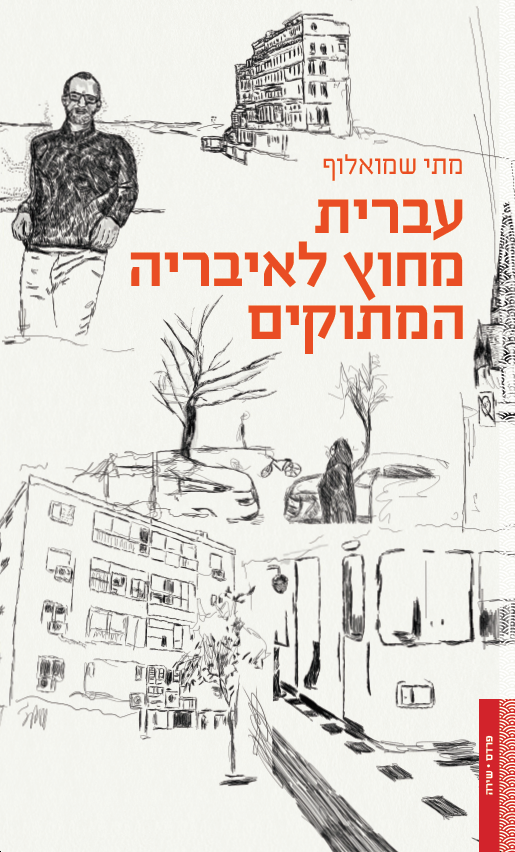
Hebrew Outside Its Sweet Insides
Poetry
Mati Shemoelof
Pardes Publishing, 2017
Language: Hebrew
Hebrew Outside Its Sweet Insides is Mati Shemoelof’s sixth poetry collection. Written around his move from Israel to Berlin, the book explores migration, language, Mizrahi identity, memory, family, love, political belonging, and the experience of living between countries and languages.
At the center of the collection is Hebrew itself. Removed from its familiar Israeli surroundings, the language encounters German and other foreign languages and begins to change. Hebrew is no longer simply a national language or a fixed cultural home; it becomes something carried across borders, a living language that breathes, struggles with, feeds on, and is transformed by other languages.
The collection continues Shemoelof’s long engagement with Mizrahi identity, class, migration and the history of his family’s movement to Israel. But from Berlin, these questions acquire a different perspective. Distance from Israel becomes a way of looking back at the country, at the Kiryat neighborhoods where he grew up, and at the Hebrew language itself.
The poems move between the political and the intimate: between questions of nationalism, exclusion and social inequality, and poems about love, parenthood, loneliness, memory and the body. The experience of exile is not presented only as loss. It can also create distance, freedom and a new relationship with language.
The opening poem establishes this position:
"מְאַהֵב שֶׁל שְׁתֵּי יַבָּשׁוֹת / מְהַלֵּךְ בְּתוֹךְ גּוּף בְּלִי קַרְקָעִית."
"A lover of two continents / walking inside a body without a ground."
One of the collection’s central ideas is that Hebrew does not stop being Hebrew when it leaves Israel. Instead, it enters into conversation with other languages.
In an early version of the poem later published in the collection, Shemoelof writes:
"וְעַכְשָׁו הָעִבְרִית נוֹשֶׁמֶת שָׂפוֹת זָרוֹת"
"And now Hebrew breathes foreign languages."
The poem was also published in Arabic under the title:
عبرية طازجة على السكين الأجنبية
"Fresh Hebrew on the Foreign Knife"
The Arabic version describes Hebrew as a language that breathes foreign languages, divides within itself, becomes curious about them, competes with them, loses to them, reconciles with them, feeds them and continues with them. The foreign language cannot simply be removed from inside Hebrew.
This relationship between languages becomes one of the book’s central poetic and political propositions: cultures do not exist in isolation. They encounter one another, influence one another and transform one another.
Migration, distance and a new Hebrew
The book asks what happens to Hebrew when it is written outside Israel. For Shemoelof, migration does not mean abandoning Hebrew. On the contrary, living in Berlin makes the relationship with the language more conscious.
The distance creates both estrangement and intimacy. Without the automatic familiarity of slang and the dominant cultural environment, Hebrew becomes something that has to be carried, questioned and reinvented.
The collection therefore belongs to a broader diasporic possibility for Hebrew literature: Hebrew can be written, developed and transformed outside the geographical borders of Israel.
As poet and critic Aviv Shnir wrote in HaOketz, the book places Shemoelof in "another external position" — creating Hebrew culture outside Israel’s physical borders and outside an ideology of aggressive nationalism. Shnir sees the encounter between the Kiryat neighborhoods and Berlin, and between Hebrew and German, as central to the book’s mature poetic perspective.
Love, grief and intimacy
Alongside its political and linguistic concerns, Hebrew Outside Its Sweet Insides is a book of love.
The poem "On the Other Side of Poetry" moves between joy and mourning, death and birth, language and intimacy. It ends with a moment of physical closeness:
"בְּכָל פַּעַם שֶׁאַתְּ מְחַבֶּקֶת אוֹתִי בַּלַּיְלָה,
מַשֶּׁהוּ בִּי נִצָּל."
"Every time you embrace me at night, / something in me is saved."
For Shnir, this movement between opposites is central to the collection: dancing and burial, birth and death, exile and freedom, foreignness and intimacy.
The book’s political voice is therefore accompanied by what Shnir calls a "soft love." The cold and foreignness of Berlin may even soften the poet’s voice, allowing another kind of intimacy to emerge.
Mizrahi identity and family memory
The collection also continues Shemoelof’s engagement with the Mizrahi experience in Israel.
The movement to Berlin does not erase this history. Instead, it allows Shemoelof to revisit his family’s migration, the social position of Mizrahi Israelis, class divisions and the absence of non-European migration stories from Israel’s dominant cultural narrative.
The book asks what happens when a poet whose family migrated to Israel from the Middle East becomes a migrant once again — this time leaving Israel for Europe.
The result is a layered experience of migration: Baghdad and Mashhad, Haifa and the Kiryat neighborhoods, Israel and Berlin, Hebrew and German.
"A lover of two continents"
At the Tel Aviv launch, poet and scholar Dr. Oshra Elpese described Shemoelof’s work as part of the transformation of the Mizrahi voice in Hebrew poetry.
She connected the collection to his earlier work and to his search for what she called a "third possibility for poetry." She described his relationship with Hebrew as one of love and conflict: he argues with the language, becomes angry with it, makes love with it and continually tests its limits.
She concluded by calling him:
"מאהב של שתי יבשות"
"A lover of two continents."
The editor on the making of the book
Poet and editor Alon Bar describes meeting Shemoelof at an international poetry festival devoted to migration. Their friendship and collaboration eventually became the editorial process behind Hebrew Outside Its Sweet Insides.
For Bar, the protagonist of the poems is the Hebrew language itself, while the speaker is a body searching for fulfillment, roots searching for soil, and memories searching for someone to remember them.
The collection was edited by Alon Bar, with Li Maman as editor of the poetry series and Shahar Sarig responsible for the cover design.
Critical response
The book received attention for the way it brings together poetry, migration, language and political thought.
Aviv Shnir described it as a personal and political book, "sweet-and-bitter" and mature, moving between the Kiryat neighborhoods and Berlin and between Hebrew and German.
Doron Braunstein, writing in Hai BaTarbut, described it as a book of longing and existential questioning, emphasizing the powerful encounter between Shemoelof’s Israeli and German worlds.
Other reviews and essays appeared in Haaretz, HaOketz, Makor Rishon, Daf 77, Salonet and other publications. The book was also discussed by writers and poets including Amir Lev, Amira Hess and Roni Someck.
Gedichte
Als wir euch durch das Gewehrvisier betrachteten, Bridges גשרים Brücken لجسور Magazine, Berlin (Aphorisma Verlag). ISBN 978-3-86575-734-0.
Selected press, interviews and recordings
Alon Bar — "How Words Became a Book", on the editing process.
"Brit Milah", interview with Shlomi Hatuka, Kan.
Mati Shemoelof in Berlin: “It Is Also Okay to Know When to Step Aside”
An interview with Mati Shemoelof by translator and writer Gadi Goldberg, published in November 2017 around the Berlin launch of Shemoelof’s poetry collection Ivrit MiHutz Le’everim HaMetukim (Hebrew Outside the Sweet Organs). The conversation explores migration, Hebrew as a minority language, Mizrahi identity, longing, diaspora, refugees, fatherhood and Shemoelof’s changing relationship with political activism. Read more.
Bechol Sarlouy, Makor Rishon — "Disconnection Without Severance."
Aviv Shnir, HaOketz — "And Now Hebrew Breathes Foreign Languages."
Moshe Granot, Makor Rishon — on Shemoelof’s engagement with the German language.
Roni Tzoref — "Thank you, Mati. Never stop 'being in migration toward the heart.'"
Yotam Reuveni, Haaretz. The answer of Iris Amsalam Hefetz on Haokets
Launches
The book was launched in Tel Aviv, Haifa and Berlin in 2017.
The Tel Aviv launch took place on October 16 at Café Shapira, with Dr. Oshra Elpese, Amir Segal, Alon Bar, Gonen Weizel and Gilad Rot.
The Haifa launch took place on October 20 at Café HaTipul, bringing together writers, poets, social activists and cultural figures.
The Berlin launch took place on November 29, 2017, at Café Kaptish, with German-Jewish poet Max Czollek, journalist and editor Hanno Hauenstein, psychoanalyst Iris Hefetz Amsalem and musician Liran Levy. Czollek read from the poem "Milk", Hefetz Amsalem spoke about the rupture behind "On the Other Side of Poetry", and Liran Levy performed three poems from the collection.
Hebrew Outside Its Sweet Insides is ultimately a book about what happens when a language leaves home — and discovers that leaving home does not mean leaving the language behind.
Book details
Title: Hebrew Outside Its Sweet Insides
Original title: עברית מחוץ לאיבריה המתוקים
Author: Mati Shemoelof
Publisher: Pardes Publishing House
Year: 2017
Language: Hebrew
Genre: Poetry