“Confessions: Coming Soon”: Roee Rosen and the Unexpressed Creativity of the Middle Floor of Our Lives
“Confessions: Coming Soon”: Roee Rosen
Mati Shemoelof
Roee Rosen, Confessions: Coming Soon, video, 8.4 min., 2007. Video projection in the upper space; paintings from 2004–2005 in the lower space, Rosenfeld Gallery.
In the upper floor, Roee Rosen’s film presents Hillel at the center of a space, against changing surfaces. He looks directly into the camera and delivers a monologue in English, a language he neither speaks nor understands. What makes this linguistic performance possible is a teleprompter from which Hillel reads a transcription of the English text in Hebrew letters. [...] The child does not speak for himself, but neither is he an actor. He is ventriloquized as an innocent and beautiful child, possessed and controlled by his father, serving as an obedient conduit for Rosen’s desires. He is brought onto the set for an advertising film, carrying the promise of a groundbreaking cinematic work.
In the lower floor of the gallery, Rosen presents gouache paintings on paper that preceded the self-portraits shown in the exhibition Ziona and the Twins at Rosenfeld Gallery approximately a year earlier. In these portraits Rosen presents himself as “covered” in excrement and humiliation, somewhere between a costume and a disguise. Also exhibited is Shit Boy, an oil painting.[1]
Roee Rosen’s Confessions: Coming Soon sends its viewers toward the future. It places his son Hillel at the center of the upper gallery, both as actor and subject. The short film—8.4 minutes long—is a kind of trailer for Rosen’s next film. Its form borrows a convention from cinema and transfers it into the sphere of the gallery and visual art.
The trailer generates expectations for Roee Rosen’s next film. Through the trailer, the gallery becomes a space of expectations that are never fulfilled. The trailer creates a fantasy in which the cinema becomes a gallery and the gallery becomes a cinema. We wait for what may, in a few months, become Roee Rosen’s next “futuristic” and “ambitious” film: The Confessions of Roee Rosen, in which he will “impose himself on three foreign workers who do not speak Hebrew in order to deliver sensational confessions from the artist’s life.”[2]
Breaking the Cinematic Convention
In this essay I will consider the trailer separately from Rosen’s proposed subsequent film. I do so in order to break with the cinematic convention and argue that the form operates differently when it is placed inside a gallery. I will resist the equivalence between the gallery and the cinema.
This may allow us to interpret the works in the upper space as a parallel to the artist’s observation of himself through the object of the artwork: a structure of expectations that remain unrealized.
I will then compare the upper gallery space, where the trailer was shown, with the second space, which contained Rosen’s paintings from 2004–2005.
Shitty Expectations of the Future and a Future Without Chocolate Coating
Hillel, Rosen’s son, is both object and subject.
On the one hand, Roee Rosen uses him to suggest that there are things that will not change. Hillel—as an actor, as Rosen’s son, and as part of a system of power relations—remains caught within relations of control.
The question is: who controls him?
Is it Roee Rosen the artist, the father, or the sovereign? Or are these deterministic forces that turn Hillel into a kind of confession that can never take place?
A trailer for a prayer that will never arrive.
A trailer composed of expectations that will never become hope, but instead only push the symbolic realm further away from the real.
[Image 3]
Hillel is instructed to raise his hand in a Nazi salute (see Image 3). The child performs the gesture as part of the instructions delivered through the teleprompter, in a film shot in a single take, without his knowing in advance what he would be asked to do.
Various stages in Rosen’s artistic work pass through the trailer and look back at us. Eva Braun,[3] for example, looks at us with the rigidity of the transformation of Rosen the artist into Rosen the sovereign: Hillel is simultaneously the actor and the son. In fact, both Rosen and Hillel become actors within larger political and theological forces.
Fiction, like the autobiography of Justine Frank,[4] enters into dialogue with the imagined cinematic biography presented here and destabilizes the Oedipal relationship between father and son—Roee Rosen and his son—as it enters the artistic medium.
A seemingly real autobiography becomes symbolic. Yet, in the trailer for a film that never materializes, the symbolic becomes detached from the real and acquires a life of its own.
The film promised to become Rosen’s next cinematic and artistic work never takes place.
Life does not happen inside the individual text. Instead, we wait for it. We live in anticipation of it. The future, in fact, takes place through our anticipation of it.
We cannot encounter the real except through a symbolic experience that includes our fantasy of expectation. Within this fantasy, we can imagine ourselves as a son who resists, whose bodily gestures rebel against interpellation, against the father, God, and the tyrant.
The imaginary autobiography of Justine Frank, or the life and death of Eva Braun, allowed us to imagine an alternative history in order to examine our own position in the past, present, and future.
Here too, the positivist axis of the past is destabilized. We do not live in the past or the future. We live through role-playing, in which we wait for something that never arrives.
Samuel Beckett is an influence on Rosen’s work: we wait for Roee Rosen’s next film—Godot—which never arrives.
Through drama, Beckett addressed the Hegelian power relationship between the slave who wants to become the master and the master who needs the slave in order to define himself. The two attempt to confront one another without recognizing that the elimination of one would leave the other without an identity.
Within this dialectical symbolism, Hillel serves as Rosen’s slave, while Rosen himself, as father, becomes trapped inside Hillel’s gestures and his immediate interpellation into the text being read to him in the trailer.
Rosen tests the boundaries of cinema through the medium of art and marks those boundaries as unknown on several levels.
First, on the historical level: who is responsible for the historical necessity that appears as a kind of confession? Do we not enter trajectories of confession governed by historical determinism, shaped by established patterns of thought and practice?
Who gives us orders, and are those orders ever actually carried out? Is confession ever realized within historical continuity?
Second, on the psychological level: both in the Lacanian sense of introducing the son into the symbolic order of the father, and in terms of relations of power and control between father and son.
Hillel, Roee Rosen’s son, is also an imagined creature in relation to Rosen’s own childhood. At the same time, he is projected as a question about the future: has Hillel been introduced into the symbolic order of Rosen, the father?
Through the trailer, Rosen asks whether he himself can resist any psychic order whatsoever—a question directed simultaneously toward the past, as memory, and toward the future, as anticipation.
Third, on the theological level,[5] the name “Hillel” loads the trailer and its central theme with a theological structure of thought.
Is praise constructed through the signifying order of religious thought, or through its secular-national version,[6] which places us within a power relationship between God or the sovereign and the believer or subject?
Hillel—as a form of praise or thanksgiving to God or the sovereign—is trapped within a sequence of interpellations that appear impossible to alter, despite death, catastrophe, and the unknown.
And yet the confessions never appear.
The next film does not happen here, at least not now.
As in the ending of Rosen’s comic book Ziona TM, where the comic drawings never appear and no coherent ending takes place, but the narrative is abruptly cut off,[7] the trailer once again confronts us with the inability to speak.
Paraphrasing Gayatri Chakravorty Spivak’s famous essay “Can the Subaltern Speak?”,[8] the trailer asks whether it is possible to give voice to the voices of the subaltern.
There is no possibility of allowing the child to resist the text. He must read everything projected onto the teleprompter and follow the instructions contained in the text.
What remains are the doubled gestures of speech: the frozen hand held inside Hillel’s other hand as he reads the text, and all the unplanned gestures that weave enormous human knowledge into the performance—knowledge that is difficult for us to read.
We are accustomed to a visual reality, but we do not necessarily know how to extract the precise meanings stored within it.
At the same time, the person exercising power also fails to perform the work of subjection completely. The child’s bodily gestures resist it; so does our response as viewers.
Perhaps this is also because behind the child, a sequence of images is projected that destabilizes the demanding relations of control embedded in the artist’s confessions and placed in the child’s mouth.
The excessive flow of images and the totality of the visual experience ultimately become a sign of the trailer genre itself—and of its parody.
From Top to Bottom and Back Again
Like the artist Kara Walker, Rosen’s art produces a form of anti-racist parody that “signifies” its own genre in a postmodern manner.[9]
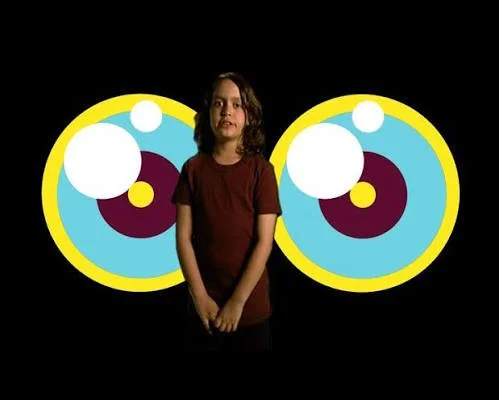
In Image 4, we see numerous eyes, like faceless animated figures, looking down from above Hillel as part of the trailer.
The eyes also constitute a doubled gaze directed at the viewers who are themselves watching Hillel.
This creates a form of irony and comic self-awareness within the cinematic text: “eyes” looking at “eyes,” and so on.
The colorful eyes become a symbolic animated audience incorporated into the text, interrupting our perception of the work as “drama.” They return us to the machinery hidden within drama.
The eyes also engage with the history of cinema through animation.
Rosen asks us to dismantle the seriousness of the relations of power embedded in the text Hillel reads.
The trailer contains backgrounds of boiling food, piles of excrement, and ironic chocolate (Image 5). It presents an industrial advertising studio: at one moment painted black, at another rendered in negative (Image 1), and at another accompanied by the techniques and sounds of a horror film.
These elements simultaneously emphasize the theological effect of confession before God and an interpellation before nationalism.
But what is the horror? What is boiling? What are the eyes?
What is the encounter between cinema and art trying to tell us as the film runs through a rapid sequence of cinematic images in the upper part of the gallery?
What changes in us as we move from the upper floor to the lower floor of the gallery?
[Image 6: Double-Self Portrait, 2005. Exhibited in the lower gallery space.]
[Image 7: ShitBoyShowers (Suicide), 2007. Exhibited in the lower gallery space.]
[Image 8: FrostedSelf5, 2004. Exhibited in the lower gallery space.]
The lower part of the gallery gives us new foundations for interpreting the cinematic text that has invaded the gallery.
On the lower floor, Roee Rosen presents paintings that preceded the self-portraits shown in the exhibition Ziona and the Twins at Rosenfeld Gallery a year earlier.
The paintings incorporate the Orientalist gaze that we had already encountered in the figure of Justine Frank (Image 8). That gaze becomes “Shit Boy,” a kind of excremental child—like sweet chocolate—who kills himself (Image 7).
The painting presents a figure made of excrement, perhaps chocolate, pouring water over itself with joy. We know that the water will soon dissolve it.
The approaching end—which is also the fact of our mortality—is the end of chocolate, of the sweet joke that distances us from the anxieties and nightmares contained within the real. It is also the end of our being so bad and ugly: that “black sun” of Kristeva.[10]
In Israel, this “black sun” takes on Middle Eastern, Oriental, African, and Asian characteristics. It begins to dissolve through the water of understanding, as an external gaze breaks apart the repressed qualities contained within it.
Will the repressed Israeli cultural subject be able to relinquish its possessions as it comes to understand the Orientalist gaze embedded within it, as part of a process of cultural decolonization?
It is difficult to know exactly how the visual works located at the bottom of the gallery—the gallery’s unconscious, its lower level, the real—communicate with the cinematic work placed on the upper floor, the symbolic.
One possible interpretation is that Rosen places “the future” in the upper part of the gallery and examines it as an expectation that never materializes, an expectation within which he lives.
In the lower part of the gallery, meanwhile, he places his own portrait, his “past,” as represented in the paintings from 2004–2005 (Images 7 and 8).
Another group of works in the lower gallery addressed Rosen’s relationship to art itself.
He showed that the “natural” gaze of art—analogous to the “cultural” and the “sexual”—is a gaze directed toward the desire for an ending.
This is the image in which a monkey paints another monkey hanging itself while simultaneously attempting to reach its own sexual organ with its tongue (see Image 6).
In the lower space, Rosen’s symbolic past, both as an artist and as a person, has almost become water filled with chocolate and excrement.
In the upper space, Rosen does not limit himself to looking toward the symbolic past. He also looks toward the symbolic future by placing his son Hillel at the center of the trailer.
Notice that Image 1 colors Hillel’s face brown, recalling the color of Rosen’s face in Image 8.
We are therefore positioned in the gap between the lower and upper floors.
Here lies the creative, artistic, and biographical unknown, as well as the social and political unknown that occurred between 2004–2005, when the portraits were completed, and 2007, when the trailer and Shit Boy were produced.
In the space between the two floors and between the two bodies of work—the film above and the paintings below—we can perhaps begin to give voice to the unknown.
On the one hand, we live in anticipation of a future that does not materialize.
On the other, we live in fear of a historical, social, biographical, and personal past that might reveal itself and dismantle the entire structure in which we stand.
There is no present between the floors.
A present of absence stands before us.
And within this emptiness, we move through the exhibition.
The medium of creating emptiness enters into dialogue with European nihilist thought.
On the lower floor there is a medium of painting that dissolves itself and resists the process of confession and cultural decolonization.
On the upper floor there is a cinematic medium that has invaded the gallery and speaks about anticipation of the future, but does not produce a confession. Instead, it presents a controlled and resistant subject.
Between them lies a medium of emptiness.
An emptiness without a medium.
And when we return to the title of the exhibition, Confessions: Coming Soon, we once again hear the fear of catastrophe threatening the comic.
Rosen is ultimately threatened by whatever might connect the future to the past—and the past to the future—perhaps because we have no way of touching it.
That thing.
Tags: Roee Rosen Confessions: Coming Soon, Roee Rosen, Confessions: Coming Soon, Israeli art, Israeli video art, art criticism, contemporary Israeli art, Roee Rosen art, Mati Shemoelof art criticism