How to Explain Hare Hunting to a Dead German Artist
An interview with Joseph Sassoon Semah on Joseph Beuys, Jewish art and German postwar culture
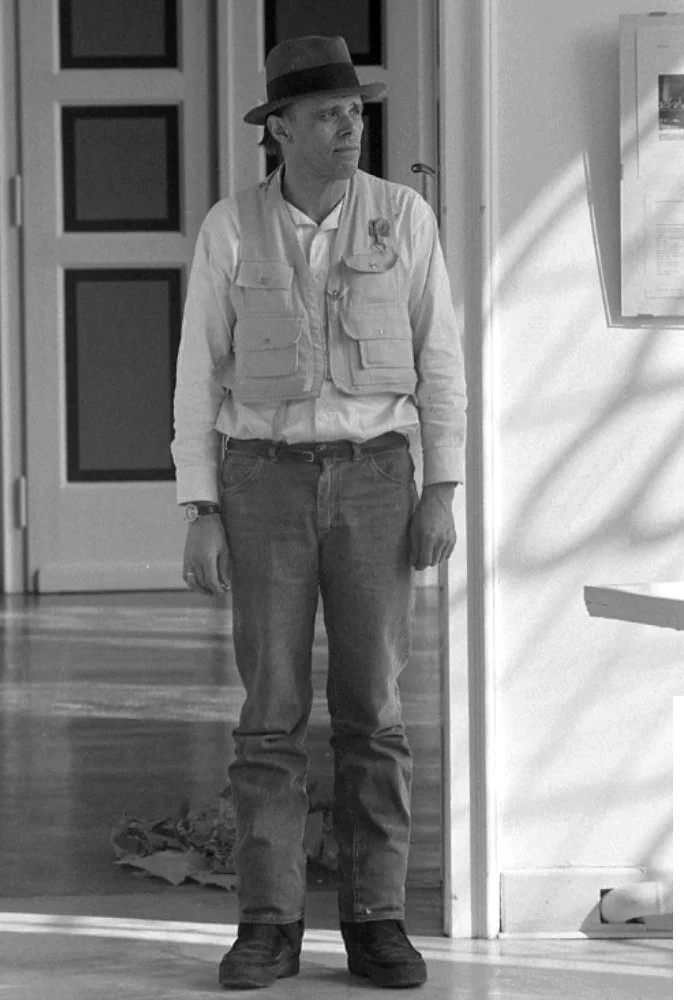
Jochen Mellin, CC BY-SA 4.0 <https://creativecommons.org/licenses/by-sa/4.0>, via Wikimedia Commons
Mati Shemoelof interviews artist Joseph Sassoon Semah about Joseph Beuys, Jewish artistic criticism, Holocaust memory and the legacy of German postwar art.
Mati Shemoelof: Next year (2021), there will be a celebration of 100 years of the renowned German artist Joseph Beuys, one of the most influential intellectuals of the 20th century. Beuys was considered the healer and shaman of postwar Germany. In Germany, numerous exhibitions, actions and performances, plays, concerts, lectures, and seminars are set to explore the equally fascinating and controversial ideas of Joseph Beuys. This will also happen in 20 institutions in 12 European cities. However, the Jewish artist Joseph Sassoon Semah wasn’t invited, in spite of his artistic dialogue with Beuys’s art, dating back a long time—with Beuys together and without him. Semah engaged in an artistic criticism of Beuys’s art from the point of view of a Jew.
Joseph Sassoon Semah: Well, they are not going to criticize him when they celebrate these 100 years. That’s why we talked with Arie Hartog, director of the Gerhard-Marcks-Haus in Bremen, Germany. We decided to answer with an art project that will be presented at the Gerhard-Marcks-Haus in Bremen, the University of Amsterdam, the Jewish Museum of Amsterdam and the Goethe-Institut of Holland. The event will be showing different critical points, mainly from my perspective, not only as an artist who has been inspired by his work. I like to elaborate on the experience of his work as a Jew.
Mati Shemoelof: On the 26th of November 1965, in Düsseldorf, Germany, the famous charismatic German artist of the Sixties, Seventies and Eighties, Joseph Beuys, is inside a gallery, while an audience is watching him from outside. His head is smeared with honey and gold leaf, and he is holding a dead hare (rabbit) in his arms. He named the performance “How to Explain Pictures to a Dead Hare.” Beuys strolled along the walls of the gallery, which were hung with his Brown Cross (Braunkreuz) paintings—crosses painted with the hare’s blood—explaining them in a language unintelligible to the hare. Beuys died on January 23, 1986. And on February 24, 1986, the Jewish artist Joseph Sassoon Semah in Amsterdam created his own artistic performative answer to Beuys with the installation (on Joseph’s birthday): “How to Explain Hare Hunting to a Dead German Artist.” For those who do not know: “hare hunting” was a euphemism used by the Gestapo for killing Jews during the Holocaust. A year later, the performance video was part of the exhibition at the Gerhard-Marcks-Haus in Bremen, Germany, which once belonged to the Gestapo headquarters. Later on, it was also installed in the Wilhelm-Wagenfeld Haus, a former prison of the Gestapo headquarters in Bremen.
Joseph Sassoon Semah: Beuys died on January 23, 1986, and my birthday happened a month and more after his death. Now, because he died, I could exchange the title “How to Explain Pictures to a Dead Hare” for this headline for my performance: “How to Explain Hare Hunting to a Dead German Artist.” At that time, Germany was not the same Germany as today. I mean, Beuys was busy with the reconstruction of “Germania” and holding us, the Jews, as a dead hare (rabbit). The question should be different. Because, in my opinion, Beuys only cared about his own wound.
Mati Shemoelof: In between Beuys’s performance and your performance, you made a public confession about your actions as an Israeli soldier at “Arti et Amicitiae,” in the city of Amsterdam. An artistic moment that was pioneering in 1986, as only very few former Israeli soldiers spoke openly about the army.
Joseph Sassoon Semah: It surprised me that Joseph Beuys didn’t make a confession about his involvement with the Nazi Army. Beuys never made a confession. And I wanted to criticize it. In 1936, Beuys was a member of the Hitler Youth. I know that it was compulsory. But actually, later on, in 1941, Beuys volunteered for the Luftwaffe (the aerial warfare branch of the Wehrmacht during World War II). In 1942, Beuys was stationed in the Crimea and was a member of various combat bomber units. He actually volunteered to be a soldier in the Nazi Luftwaffe (nobody asked him). He dropped bombs on innocent people. In his brilliant way, Beuys transformed his subjectivity into the suffering of the German soldier in the Second World War. In that odd way, Beuys became a victim.
Mati Shemoelof: One of the famous phrases of Beuys is “Every man is an artist.” Beuys was part of the Düsseldorf art school, where he demanded that the art school open its doors to all the people who wanted to be an artist. The art school kicked him out because of his radical demand. Can you elaborate more about your artistic answer to Beuys?
Joseph Sassoon Semah: I created a similar environment in my performance in Amsterdam. I sat on an aluminum office chest of drawers with a chair that belonged to a waiting room of a Gestapo waiting room in Berlin. I had a wine glass on the window. A neon light under my chair. In between copper plates, I had a Talit (a Jewish prayer shawl). I was holding a hare (a rabbit) which I cast from bronze. One of the code words of the Nazi Wehrmacht was “JAG den Hasen” (“We are going to hunt the rabbits”). And they meant we are going to hunt the Jews. Beuys could have chosen any other animal. But, of course, he had chosen the hare (rabbit). He walked with the dead rabbit in the gallery, where he did the performance and explained to him the painting that he did with his own blood in a language that nobody understood. I concluded that he tried to speak with the hare in Hebrew.
Mati Shemoelof: The art historian and curator Gideon Ofrat wrote that you converted Beuys into Judaism. On one hand, you were holding the rabbit and the other was placed on your forehead in order to symbolize pain and, at the same time, deep thinking. There was a neon light on the wall, symbolizing the eternal God’s light that answers the cross that was underneath the chair and the wine glass—symbolizing the crucifixion of Jesus Christ. Have you met Beuys?
Joseph Sassoon Semah: I met him twice. Once in Berlin, at the National Gallery. He was a kind man, and he invited me to his home, but I didn't go. We met again, also in Berlin, just before I left for Amsterdam at the beginning of the Eighties, and talked for half an hour. Yes, he was aware of my work, but he was the clean, pure face of Germany after WWII, and I was just a young artist.
Mati Shemoelof: It looks like you have a love-hate relationship with him. On one hand, so many of your art pieces are in dialogue with his art. On the other hand, you can’t stand the place that he took as a victimizer in German and European art. And so, I have to ask you, why didn’t you go to his house?
Joseph Sassoon Semah: Maybe I wasn’t really occupied with him at that time. Maybe postwar Germany wasn’t really in my focus. Around 1982, I left Berlin and it was easier for me to work in Amsterdam. In 1982, I wrote a letter to Albrecht Dürer (a German painter, 1471–1528) and explained to him my thoughts about Luther and Beuys.
Mati Shemoelof: If Beuys was alive, how do you imagine his reaction to the Jewish performance you created following him?
Joseph Sassoon Semah: In his ironic way, he would have rejected me. He did already with the hare (rabbit), holding me, a dead Jew, in his hand.
Mati Shemoelof: Hans Peter Riegel, one of Beuys’s biographers, mentioned big parts of Beuys’s patrons and friends who were ex-Nazis; some of them did their best to hide their Nazi past. From Beuys’s Nazi Army incident (as his airplane was shot down), Beuys fashioned the myth that he was rescued from the crash by nomadic Tatar tribesmen, who had wrapped his broken body in animal fat and nursed him back to health. According to his version, they told him: “nje nemiecky, du Tatar”—“You are not a German, you are a Tatar.” Records state, however, that Beuys was conscious, recovered by a German search commando, and there were no Tatars in the village at that time. When Beuys talked about World War II and the Third Reich, it always sounded as if he had experienced a different dictatorship and a different war. It was as if everything hadn't been quite so bad and as if Kleve, the industrial town in the Lower Rhine region where he grew up, had not been quite as pervaded by Nazi mania as the rest of Germany, the biographer concludes.
Joseph Sassoon Semah: Beuys was a soldier who came back from war and started to create through his personal pain. He transformed from being a victimizer to a victim. I don’t really trust this social order that he created.
Mati Shemoelof: Joseph Beuys had an enormous influence on Israeli art in the seventies when it comes to healing, and focuses on selected works of Tamar Getter, David Ginaton and Moshe Mizrahi and others. In 1973, David Ginaton went to Joseph Beuys’s home in Düsseldorf, after not finding him at the academy. He kneeled in front of the artist’s house as if he was a god.
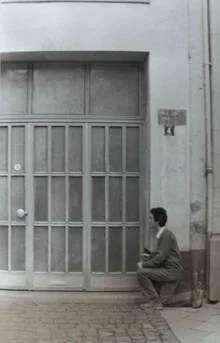
David Ginaton, Beuys admiration. 1973. From the collection of the artist.
Joseph Sassoon Semah: When Ginaton kneeled in front of the house of Beuys, I found it so sad to see such an image. I guess it should be the other way around. And you can see the power of the symbols. I don’t know why he did it. Ginaton was an Israeli soldier who was in Germany. Maybe the fascination of soldiers was connecting them.
Mati Shemoelof: How come you have a different perspective from that of the European Israeli artist? Do you connect it to your Baghdadi origins? Is the entering of Nazi ideology into Iraq connected in some undercurrent way to your criticism of Beuys’s work? You were born in Baghdad, Iraq, in 1948. Your grandfather, Hacham Sassoon Kadoorie, was the chief rabbi of Baghdad's Jewish community until his passing in 1971, even after they had all emigrated to Israel.
Joseph Sassoon Semah: Of course. It is not only about the Germans. It is about Western ideology. And it affects the whole cultural world, including the works of Beuys. And, of course, indirectly it affects the lives of Jews in the Arab world. The word “anti-Semitism” can’t be taken seriously in the Arab lands because they are also Semitic. Well, I am a Babylonian Jew, and I don’t succumb to all of the construction of the silence around Beuys. I am free from it. I can read it in a totally new way. I mean, it took me time.
Tags
Joseph Beuys · Joseph Sassoon Semah · Jewish Art · German Art · Postwar Art · Holocaust · Art and Memory · Berlin · Amsterdam · Art Writing
Internal links
Inside the article: