Questions of an Arab-Jewish Diaspora
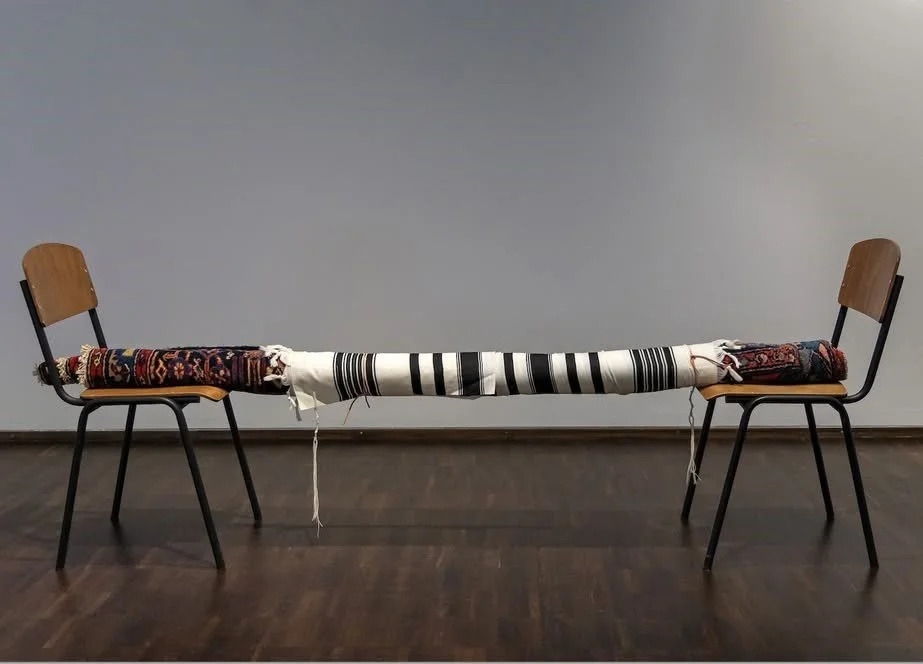
Joseph Sasson Semach, 1983 גלגול שטיח Carptet Reincarnation ROLLING: [Baghdad / Jerusalem / Amsterdam]. Photo: Eva Jünger. Jewish Museum Hohenems.
Source - Shemoelof, M. (2024). Fragen (nach) einer arabisch-jüdischen Diaspora. In Yalla – Jüdisch-arabische Begegnungen (Exhibition catalog/accompanying book). Jüdisches Museum Hohenems.
German and then English
Fragen (nach) einer arabisch-jüdischen Diaspora _Mati Shemoelof
Als arabischer Jude ist es schwierig, die sprachliche Leere zu beschreiben, in der ich in Berlin lebe. Die irakische und persische Sprache meiner Großeltern aus dem Irak und Iran auf beiden Seiten meiner Familie findet keinen Widerhall in der deutschen Kultur, und so muss ich mit dem Mangel an regionalen, kultu- rellen und liturgischen Zugehörigkeiten leben. Es gibt keine arabisch-jüdische Geschichte, auf die ich mich zeitlich oder örtlich beziehen könnte. Ich musste hier neu anfangen, mit dem Rucksack meiner Geschichte auf den Schultern, eine Geschichte, die ich als Dichter in jede Diskussion und jede Lektüre miteinbinde. Gerade in Deutschland, wo Israel ein eigenes und etabliertes Narrativ hat, das unverhandelbar scheint, erlebe ich die Unkenntnis gegenüber der jüdisch-ara- bischen und misrachischen Tradition als Herausforderung: Wie kann ich den Reichtum der Literatur und meines kulturellen Bewusstseins in ein neues Land übertragen? Ist eine Übertragung überhaupt vorstellbar? Einwandernde sind auf ihrer Reise in ein neues Land oft isoliert. Sie können zwar ihre persönlichen Bibliotheken mitbringen, aber der ständige Kampf um soziale Gerechtigkeit und Anerkennung der eigenen Traditionen erscheint entmutigend.
Das Wesen des Misrachi-Narrativs in Israel zielt darauf ab, ein alternatives, mul- tiethnisches und multikulturelles Denken zu schaffen. Der Begriff, Misrachi (also, östlich oder, orientalisch') war freilich zum Zeit- punkt der Staatsgründung Israels eine abwertend stereotype Zusammenfassung aller arabischen JüdinnenJuden, unabhängig ob sie aus dem Nordkaukasus, dem Südjemen, dem Ostirak oder Westmarokko stammten. Misrachi im Israel der fünfziger und sechziger Jahre bedeutete, Teil einer, Unkultur zu sein, eine, die in der Hierarchie der Kulturen ganz unten steht.¹ Die osteuropäischen JüdinnenJuden, die sich plötzlich als westliche Jüdin- nenJuden wahrnahmen, schufen das Bild der misrachischen/asiatischen/afrika- nischen JüdinnenJuden als Menschen mit einem problematischen Hintergrund und mit der Begründung keine europäische Kultur zu haben, müssten sie einen, Eingliederungsprozess in die israelische Gesellschaft durchlaufen.² Die ethnisch-rassistische Hierarchie der jungen israelischen Gesellschaft ver- deutlicht ein Ausspruch ausgerechnet von Hannah Arendt während des Eichmann- Prozesses: „Mein erster Eindruck: Oben die Richter, die besten des deutschen Judentums. Darunter die Staatsanwälte, Galizier, aber immerhin Europäer. Organisiert wird alles von einer Polizei, die mir eine Gänsehaut bereitet, die nur hebräisch spricht und arabisch aussieht. Unter ihnen sind einige geradezu bru- tale Typen. Sie würden jedem Befehl gehorchen. Und draußen vor den Türen der orientalische Mob, als wäre man in Istanbul oder einem anderen halbasiatischen Land."3 Doch die Bezeichnung Misrachi wurde zunehmend als Eigenzuschreibung über- nommen: Mit dem Wadi-Salib-Aufstand (1959) und der Black-Panther-Bewegung $(1971/72)$ verwendeten arabische JüdinnenJuden den Begriff Misrachi, um gegen rassistische Vorurteile und die wirtschaftliche Benachteiligung durch die Aschkenasischen Juden zu rebellieren. In Israel wird die misrachisch-arabisch-jüdische Frage im Rahmen der sogenann- ten, vergessenen Million' kontextualisiert, dabei werden die palästinensischen Flüchtlinge und die jüdischen aus den arabischen Ländern gegeneinander aus- gespielt. Wie reagieren arabische JüdinnenJuden auf dieses Narrativ? Wehren sie sich gegen die politische Vereinnahmung ihrer Geschichte durch den Staat Israel, oder erkennen sie dieses Framing an und beteiligen sich daran? Welche Möglichkeiten gibt es für arabische JüdinnenJuden außerhalb Israels, gegen die israelische Besatzung zu demonstrieren, zu agieren? Wie gehen arabische JüdinnenJuden außerhalb Israels mit palästinensischen Flücht- lingen um, die (ebenfalls) längere Zeit in der Diaspora gelebt haben, und welche Dynamik prägt diese Interaktionen? Wie kann nun dieses in Israel verwurzelte Narrativ in ein neues, ein anderes Land übertragen werden? Ist ein solcher Transfer überhaupt möglich? Können die Gedichtbände, die ich in Deutschland veröffentlicht habe, den historischen, kulturellen, sprachlichen, sozialen und politischen Kontext miteinbeziehen? Wie können die literarischen Werke - ohne ein solches kontextuelles Verständnis interpretiert und gewürdigt werden? Der von den arabischen JüdinnenJuden empfundene Mangel an Verständnis ist tiefgreifend, komplex und vielschichtig. Um einen Dialog führen zu können, benötigt es sowohl ein historisches Verständnis für die lange jüdische Geschichte im Raum, den wir heute als Arabisch bezeichnen, als auch ein Verständnis für die Lebensrealitäten arabischer JüdinnenJuden im heutigen Israel. Ein Dialog wird durch das Fehlen einer breiteren historischen Perspektive behindert, die häufig durch nationale Narrative verengt wird, jüdische, zionisti- sche wie panarabische. Weder in den jüdischen noch in den arabischen Gemein- schaften Deutschlands ist Kenntnis über die Geschichte jüdisch-arabischer Beziehungen verbreitet. So vernachlässigen viele arabische Kulturfestivals die Jahrhunderte alte jüdisch-arabische Dimension, aus unterschiedlichen, aber meist gegenwärtigen politischen Gründen, mit problematischem Ergebnis. Es ist für mich eine schmerzliche Realität, dass die Mehrheit dieser weltoffenen und diversen Gesellschaft in Berlin unfähig ist, meine vielfältige Identität als arabischer Jude jenseits meines israelischen Passes anzuerkennen. Um diese historische und kulturelle Kluft zu überbrücken, ist die Förderung von integrati- veren und fundierteren Dialogen unerlässlich.
Was bedeutet arabisch-jüdische Diaspora? Während meines zehnjährigen Aufenthalts in Berlin bin ich immer wieder auf Fragen nach der Bedeutung der arabisch-jüdischen Diaspora gestoßen.4 Mir wurde gesagt, dass diese politisch-ethnisch-sozialen Kategorien nicht mehr relevant seien, sobald man Israel verlassen habe. Viele Menschen beto- nen, dass sie sich ein neues Leben aufbauen wollen und es wenig sinnvoll sei, ihre früheren Positionen in Israel in den Blick zu nehmen. Ich respektiere diese eigene Identifizierung, auch wenn ich der Meinung bin, dass die Diskussion über die misrachische/arabisch-jüdische Diaspora aus mehreren Gründen wichtig ist:
Über die ungleiche Verteilung von symbolischen und materiellen Ressourcen zwischen den verschiedenen Bevölkerungsgruppen in Israel ist bereits viel geschrieben worden. Ein Mensch, der aus einer Unrechtsgesellschaft kommt, hat nicht die gleiche Ausgangsposition wie andere. Auf dem Höhepunkt der Proteste für soziale Gerechtigkeit im Jahr 2011 arbeitete ich als freiberuflicher Kolumnist für die Zeitung Israel Hajom. In einer der E-Mails schlug ich dem Redakteur der Zeitung vor, eine Kolumne über die aschkenasische privilegierte Einwanderung nach Berlin zu schreiben. Ich wollte schildern, wie die israelische Elite ihre Kinder nach Berlin schickt, um sie von der sinkenden israelischen Titanic zu retten. Doch der Artikel wurde nie geschrieben. Als ich selbst nach Berlin zog, fühlte ich mich wie ein personifizierter Irrtum, der in Berlin spazieren ging. In einer Kolumne für Haaretz beschrieb ich, wie es sich anfühlt, Misrachi in Berlin zu sein und erhielt daraufhin sehr harsche Reaktionen von der aschkenasischen Bevölkerung in Berlin. Sie hielten sich schlicht für nach Berlin ausgewanderte Israelis. Indem ich die innerjüdisch-ethnische Kategorie thematisierte, entlarvte ich ihre Klasse und die ethnischen Privilegien, in denen sie aufgewachsen sind. Sie dachten, sie würden sich in Berlin neu erfinden. Und unterstellten mir, mein Schreiben sei das Problem. Aber man kann nicht einfach aus Israel wegziehen und die Privilegien ignorie- ren, die Teile der Bevölkerung genießen, während gleichzeitig andere Bevöl- kerungsgruppen von den Zentren der Macht ausgeschlossen sind, sei es in der Kultur oder in der Wissenschaft.5 Es ist offenbar leichter, sich zu outen und über die Möglichkeiten zu sprechen, in Berlin ohne Kinder in einer neuen Beziehung und Sexualität zu leben. Sehr viel schwieriger dagegen ist es, über komplexe ethnische Klassenfragen zu sprechen, die aber genauso wichtig für diese Diskussion sind. In der Diaspora herrscht nach wie vor die eurozentrische Annahme vor, dass die Mehrheit der israelischen Juden aus Europa stammt. Der große Reichtum der arabisch-jüdischen Geschichte und Kultur bleibt weitgehend unerkannt, sowohl in ihrer Erzählung als auch als gelebte Realität. Selbst im Sprechen über die jüdisch-arabische Bevölkerung, werden europäische Kategorien verwendet. Die lange Beziehung zwischen Judentum und Islam kann nicht gleichermaßen dargestellt werden, wie die Beziehung zwischen Judentum und Christentum. Seit der Zerstörung des Tempels und dem babylonischen Exil bestanden große jüdische Gemeinschaften in der Region, die man später gemeinhin als arabi- schen Raum ansah.
Die Lebenswelt der Jüdinnen und Juden in der vorislamischen Welt schuf eine neue Kultur, die es zuvor nicht gab. Die JüdinnenJuden beteten zu Gott und bedienten sich der aus der arabischen Kultur übernommenen Tonleitern (maqams). Dieser Synkretismus nahm zwei Elemente auf, die nicht in einem Körper lebten, und verschmolz sie zu einem einzigen Körper. Rabbi Ovadia Josef, der Führer der Schas-Bewegung, liebte die arabische Musik so sehr, dass er seinem eigenen Kantor, dem Oud-Spieler Moshe Habusha, erlaubte, auch populäre arabische Musik zu spielen, wobei er die Texte der Liebeslieder in religiöse Gesänge umschrieb. So wurde sowohl die religiöse Musik von der islamischen Musik als auch die populäre Musik von der misrachi- schen Kultur beeinflusst. Wenig überraschend, dass die misrachische Musik bis heute einen ständigen Dialog mit der arabischen Welt führt. Als ich nach Berlin kam, betete ich in der Synagoge Fraenkelufer. Aber leider waren die arabisch-jüdischen, Pijjutim (die Dichtung der jüdischen Liturgie, die gesungen werden) nicht dieselben, die ich in der marokkanischen oder irakischen Synagoge in meinem Stadtteil in Haifa zu hören gewohnt war. Im Jahr 2021 erhielt ich ein Stipendium des Berliner Senats, um ein Festival über die Union des Nahen Ostens (die nach einem künftigen Frieden mit den Paläs- tinensern gegründet werden soll) mit zu organisieren. Eine der Veranstaltun- gen, die ich vorschlug, waren arabisch-jüdische Pijjutim, weil ich glaubte, dass diese Musik, die die Juden all die Jahre benutzt haben, eines Tages auch eine Brücke zur Musik der Zukunft sein würde. Das Pijjut Im Nin'alu" ( Wenn das Tor der Großzügigkeit geschlossen wird") von Rabbi Shalom Shabazi aus dem Jemen wurde in der Interpretation von Ofra Haza schließlich sogar ein Hit in Europa. Ich habe keinen, arabischen Juden' gefunden, der diese in Berlin singen konnte, doch der aschkenasische Kantor Assaf Levitin kennt und singt diese Lieder ganz wunderbar. Zusammen mit einem syrischen Flüchtling an der Oud, Mazen Mohsen, trug er diese Pijjutim mit großem Erfolg vor und die deutsche Presse war von dem Ereignis begeistert. So konnte ich für einen Moment meine Synagoge als misrachische Synagoge neu erschaffen. Die Synagogengemeinde war damit einverstanden, aber die jüdische Gemeinde in Berlin reagierte mit Unbehagen. Vielleicht lag es daran, dass wir eine Syn- agoge politisieren wollten. Vielleicht lag es daran, dass wir im Namen eines symbolischen Friedens mit den Palästinenserinnen und der Nahost-Union einen Muslim und einen Juden in eine Synagoge aufgenommen haben. Auf jeden Fall verstanden wir, dass die jüdische Gemeinde in Berlin, die sowohl die Interessen der hier schon seit Jahrzehnten lebenden oft selbst aus Osteuropa stammen- den JüdinnenJuden als auch der jüdischen Eingewanderten aus der ehemaligen UdSSR vertritt, sich unwohl fühlte. Die jüdisch-arabische Kultur ist keine Frage der Herkunft, sondern ein offenes Gefäss, ein Raum, den man betreten und studieren kann. Die Anwesenheit von arabischen JüdinnenJuden in der Diaspora wird immer wieder dem, Profiling unterworfen, einem System der ständigen Identifi- zierung, das sowohl positive als auch negative Folgen haben kann. Araberinnen in Berlin kommen auf mich zu und beginnen ein Gespräch auf Arabisch. Dagegen werde ich an Flughäfen angehalten und muss mich befragen lassen. Das jüdisch-arabische Narrativ hat im Gegensatz zum jüdisch-europäischen Narrativ nicht das gleiche symbolische Gewicht der Anerkennung. Ich war einmal in einer bekannten literarischen Kultureinrichtung in Berlin zu Gast und fragte das hochkarätige Publikum, wer der berühmteste misrachische Dichter in Israel sei, der vor kurzem den Israel-Preis für seinen literarischen Beitrag erhalten habe. Aber niemand konnte mir den Namen Erez Biton nennen. Sie lasen und kannten Dichter wie Natan Zach oder Yehuda Amichai, hatten sie zu Lesungen eingeladen. Aber misrachische Dichter waren für sie eine unbekannte Welt. Die Überschneidung von Religion und misrachischem Denken in Israel hat einen Traditionalismus hervorgebracht, ein ursprünglich religiöses Konzept, das sich zu einem sozialen, identitären und politischen Konstrukt entwickelt hat. Wenn sich misrachische Juden außerhalb Israels bewegen, stellen sich komplizierte Fragen zu den komplexen Beziehungen zwischen Religion, Nationalismus und ethnischer Zugehörigkeit. Hier einmal ein vorläufiger Katalog solcher Fragen. Er ist lang und bisher wenig beachtet - und so kann hier nur dazu ermuntert werden, sich diesen Fragen endlich zu stellen. Wie verwandelt sich zum Beispiel das traditionelle jüdische Element in einen Raum des nicht-souveränen Judentums außerhalb Israels? Halten arabische JüdinnenJuden weiterhin jüdische Traditionen aufrecht? Gibt es arabisch-jüdi- sche Synagogen in der Diaspora? Wie wird der jüdische Kalender neben einem christlichen oder einem anderen religiösen Kalender eingehalten? Was geschieht, wenn die hebräische Sprache auf Fremdsprachen trifft? Entsteht ein neuer Hybrid, begleitet von einem neuen Slang? Was verrät diese sprachliche Verschmelzung über die hebräische Sprache in der Diaspora? Ist das Hebräische außerhalb Israels eine eigenständige Sprache, die sich deutlich von der israelischen Variante unterscheidet? Wie wird das Hebräische außer- halb Israels aufrechterhalten, und welche Rolle spielen die arabischen Juden bei seiner Bewahrung? Welche Institutionen werden eingerichtet, um die hebräische Bevölkerung in der Diaspora zu unterstützen, und wie wird die Darstellung der arabischen JüdinnenJuden und ihrer Geschichte in diesem Zusammenhang behandelt? Welchen Status hat das Arabische unter den arabischen JüdinnenJu- den in der Diaspora? Wie ist die arabisch-jüdische Kultur, Sprache oder der Dialekt in den breiteren hebräischen Kontext integriert? Gibt es ein Muster ethnisch geprägter Auswanderung, und in welchem his- torischen Kontext haben die Menschen Israel verlassen? Wie wurden sie in den Gastkulturen aufgenommen, und welchen Einfluss haben sie auf die Gesellschaf- ten innerhalb und außerhalb Israels hinterlassen? Ich untersuche den Einfluss der politischen, sozialen und ethnischen Ein- und Auswanderungen auf Israel und andere sich neu entwickelnde Nationen. In den 1970er-Jahren gab es beispielsweise eine bedeutende Auswanderung misrachi- scher Israelis in die USA, die von den Möglichkeiten im Ausland profitierten. Wie wird diese Auswanderung heute gesehen? Welche Dynamik kennzeichnet die Interaktion zwischen diasporischen arabisch-jüdischen Gemeinschaften und Israel? Gibt es für diese Gemeinschaften außerhalb Israels eine ausgeprägte ethnische Komponente ihrer Identität? Welche Definition ist für jedes Land der Diaspora zutreffend? Wie prägt die Kultur der Diaspora Israel? Was passiert, wenn wir literarische Werke von arabischen Jüdinnen*Juden lesen, die außerhalb Israels geschrieben wurden? Erlaubt es die Diaspora, unterdrückte, zum Schweigen gebrachte oder ausgeschlossene Stimmen zu hören? Lässt die misrachische Diaspora gerade wegen ihrer Existenz außerhalb nationaler Grenzen utopische Ideen aufkeimen? Im Jahr 2021 kuratierten Hila Amit, Ala Obeid und ich das oben bereits erwähnte viertägige Festival in Berlin, das sich um die Idee einer Nahost-Union drehte. „Eine Union zu bilden bedeutet, sich über Unterschiede hinweg im Namen eines gemeinsamen Ziels, einer Forderung oder einer Zukunftsvorstellung zusammen- zuschließen. Im Kontext dessen, was als, Naher Osten' bekannt geworden ist, ist die Vorstellung einer solchen fortschrittlichen Union, die souveräne Grenzen überschreitet und sich wirklich hinter einem gemeinsamen Ziel vereinigt, ausge- sprochen utopisch. Die Zwänge des rassistischen Kapitalismus, die festgeschrie-
benen Grenzen und die koloniale Vorstellung vom, Nahen Osten' selbst machen es so schwierig. Der Vorschlag eines solchen Zusammenschlusses setzt daher die wahrhaft fantastische Möglichkeit eines Auswegs voraus" (so hieß es im Konzept dieses Festivals), ein neuer Weg, der am Tag nach dem Friedensschluss zwischen Israel und Palästina verwirklicht werden sollte. Das Festival brachte JüdinnenJuden und Araberinnen, Israelis und Paläs- tinenserinnen zusammen. Das zwischen uns geschaffene Vertrauen ermög- lichte eine einzigartige Verbindung zwischen JüdinnenJuden und Araberinnen sowie der arabisch-jüdischen Diaspora und schuf kulturelle Räume, die inner- halb der Grenzen Israels unvorstellbar wären. Dieses Projekt verband unsere persönlichen Geschichten, die in Familien mit einer langjährigen Verbindung zum Nahen Osten wurzeln, mit einem gemeinsamen Gefühl der künstlerischen und politischen Verantwortung, sich mit den übergreifenden Fragen der Region auseinanderzusetzen. Berlin diente als Zentrum, welches dieses gemeinschaft- liche, künstlerische, nahöstliche Projekt ermöglichte. Und daraus ergab sich ein weiterer Katalog von Fragen: Wie beeinflusst die Kultur der Diaspora die Kultur der Einwanderungsländer? Im Zusammenhang mit Deutschland stellt sich zum Beispiel die Frage, wie israeli- sche Einwanderer mit der traumatischen Geschichte des Holocausts umgehen und wie die Gegenwart damit umgeht. Erhalten misrachische oder palästinensische Emigrantinnen eine Plattform, um ihre Perspektive auf Themen artikulieren zu können, die traditionell mit dem aschkenasischen Narrativ in Verbindung gebracht werden? Genau das haben wir getan, als wir das Middle East Union Festival kuratiert haben - wir haben den Berliner Diaspora-Raum genutzt, um ein neues Narrativ zu schaffen, das den arabisch-jüdischen Menschen verkörpert, der diese sogenannten binären Elemente zusammenhält. Wir haben sowohl die jüdische als auch die palästinen- sische Diaspora einbezogen, um die Landschaft des kulturellen Aktivismus in Berlin neu zu gestalten. Bislang konzentrierte sich der Aktivismus in der Stadt weitgehend auf das Gedenken an die Opfer des Holocaust oder die Unterstützung von Organisa- tionen wie Breaking the Silence und Combatants for Peace, die sich gegen die Besatzung wenden. Wir verfolgten jedoch einen anderen Ansatz: Wir setzten unsere Kräfte ein, um ein neues politisches Werk zu schaffen - eines, das aus der arabisch-jüdischen Erinnerung erwächst und sowohl die Gegenwart als auch die Zukunft neugestaltet.
Fazit - Der arabische Jude in Berlin: Ein anderes Babylon Doch noch einmal zurück zu dem arabischen Juden, der in Berlin lebt, der so oft einen tiefen Mangel an Orientierung spürt. Diese Stadt mit ihrer reichen Geschichte und pulsierenden Kulturszene ist weit entfernt von den Orten, die meine Identität geprägt haben - Haifa und Bagdad. Die babylonischen Jüdinnen und Juden, die an die Flüsse Babylons verbannt wurden, führten ein Leben im Exil und weinten um ihre verlorene Heimat. In ähnlicher Weise finde ich mich an der Spree wieder und trauere um einen verlorenen Ort in Haifa oder Bagdad. Berlins Faszination für seine „Berlin Babylon"-Identität, sei es durch popu- läre Serien oder seine Rückkopplung mit der Geschichte der Weimarer Republik, erinnert mich ständig an meine eigene, etwas andere babylonische Existenz. Während die Erzählung der Stadt von Dekadenz und Wiedergeburt handelt, wurzelt meine Geschichte in der Vertreibung und der Suche nach Zugehörigkeit. Berlin mit seinem „Berlin-Babylon"-Rummel übersieht oft die Perspektiven von Menschen wie mir, die den Konflikt durch eine andere Brille betrachten. Meine Haltung ist nicht nur eine politische, sondern eine zutiefst persönliche, die in einem einzigartigen historischen und kulturellen Kontext verwurzelt ist. Wenn ich der Spree entlang spaziere, denke ich über die komplexen Geschich- ten nach, die meine Identität definieren, und stelle mir vor, wie ich in Bagdad an Euphrat und Tigris entlanglaufe. Die Erzählungen des Berliner Babylons über den kulturellen Aufschwung der Weimarer Republik ist fesselnd, aber sie ist nicht die meine. Mein Babylon ist ein Exil und eine Sehnsucht, eine stän- dige Suche nach einem Ort, der das reiche Geflecht der arabisch-jüdischen Geschichte und Identität annimmt und anerkennt. Berlin mag eine Stadt der Erneuerung sein, aber für mich ist es auch ein Ort der Erinnerung und des Nachdenkens, ein Ort, an dem ich weiterhin nach meinem verlorenen Babylon inmitten der geschäftigen Metropole suche. Ich möchte erforschen, wie die Erfahrung eines arabischen Juden in Berlin einen einzigartigen Blick auf zeitgenössische Themen wie Antisemitismus, Migration, kulturelle Identität und sogar den Holocaust ermöglicht. Es beginnt mit der ergreifenden Darstellung des Gefühls, in dieser Stadt eine Person ohne Kontext zu sein. Das ist die Essenz der Erfahrung eines arabischen Juden in Berlin: ein Leben ohne die historischen, kulturellen, religiösen und sozialen Verankerungen, die Berlin, Deutschland und sogar Europa ausmachen.
,Arabische Juden' sind Jüdinnen und Juden, die schon lange vor dem Aufkom- men des Islams als integrales Element dieser Region lebten., Islamischer Raum', ,arabischer Raum', diese Begriffe sind geopolitische Kategorien, die Besitzan- sprüche anmelden, Hegemonien begründen sollen, aber sie stehen in der Reali- tät für ein Geflecht von kulturellen und historischen Identitäten, die durch die Beziehungen zwischen JüdinnenJuden und Musliminnen, aber auch von einer Vielzahl von ethnischen Gruppen in Nordafrika und dem Nahen Osten geprägt ist, von Marokko bis zum Jemen und im Norden bis zum Iran, der Türkei und den Golfstaaten. Die Familie meiner Mutter ist aus dem Irak nach Israel eingewandert und gehört zur Bagdadi-Gemeinschaft, die ihre Wurzeln auf Juden zurückführt, die nach der Zerstörung des Tempels im Jahr 70 v. d. Z. nach Babylon verbannt wur- den. Die Familie meines Vaters stammte aus Mashhad im Nordiran und Damas- kus, der Hauptstadt Syriens. Beide mussten ihre Heimatländer verlassen, um im Exil zu leben, ohne zurückkehren zu können. Es gibt eine tiefe Verbindung zur arabischen Geschichte und Kultur im breiteren Kontext von Exil, Enteignung, Feindseligkeit, Rassismus, Synkretis- mus, Vielfalt und Fragen der Identitätspolitik. Aschkenasische Juden können nach Europa zurückkehren, sich europäische Pässe besorgen und auf ein Haus in irgendeiner Straße in Berlin zeigen und sagen: „Hier hat meine Großmutter gewohnt." Im Gegensatz dazu kann ich nicht nach Bagdad, Mashhad oder Damaskus zurückkehren wo meine Vorfahren lebten und wo die historischen Wurzeln meiner Familie liegen - und die entsprechende Verbindung behaupten. Das Zusammentreffen von Jüdinnen und Juden mit Araberinnen und Arabern brachte eine neue kulturelle Vielfalt hervor. Das sehen wir heute an den berühmten arabisch-jüdischen Musikern wie dem bekannten Israeli Dudu Tassa, der die Musik seines irakischen Großvaters und Großonkels Saleh und Daoud al-Kuwaity, Pioniere der irakischen Musik, an einen postmodernen Sound anpasst. Tassa hat kürzlich den Gipfel der Weltmusik erreicht, indem er mit dem Radiohead-Gitarristen Jonny Greenwood auftrat und Aufnahmen machte. In mei- nem Roman Der Preis (der inzwischen von Palm Art Press aus dem Hebräischen ins Deutsche übersetzt wurde) beschäftige ich mich mit einer weniger bekann- ten Geschichte: JüdinnenJuden, die sich nach der Gründung Israels im Jahr 1948 gegen eine Einwanderung entschieden. Einige dieser JüdinnenJuden beschlos- sen sogar, zum Islam zu konvertieren. Diese Erzählung über das Verbleiben in Bagdad dient nicht nur als historischer Bericht, sondern auch als Mittel, um unseren geopolitischen Platz als Israelis im Nahen Osten zu überdenken. Sie ver- tritt eine arabisch-jüdische Perspektive und behauptet, dass wir Teil der arabi- schen Welt sind. Aber akzeptiert die arabische Welt uns und unsere Geschichte? Erkennt die europäische Welt unsere einzigartige Identität an? Wann ist ein Deutscher zum ersten Mal auf die Existenz eines,arabischen Juden gestoßen? Und welche Stellung haben wir im israelischen Bildungssystem? Vor dem Massaker vom 7. Oktober und dem tragischen Gaza-Krieg konnte ich aufgrund meiner Herkunft auf Spielplätzen leicht mit arabischen Familien in Kontakt treten. Aber nach dem 7. Oktober hat sich das geändert. Wir können derzeit in Berlin nicht über arabisch-jüdische Beziehungen sprechen, obwohl unsere Vorfahren seit Hunderten von Jahren mit Musliminnen und Araberin- nen zusammenleben und wir eine gemeinsame Kultur haben. Wir werden immer nur durch unseren israelischen Pass gesehen. Aber was sie nicht wissen, dieses Land hat uns als Bürger*innen zweiter Klasse geschaffen und uns nie etwas über unsere arabische Kultur beigebracht (das formale Bildungssystem hat das immer noch nicht geändert). Misrachis in Israel arbei- ten noch immer daran, diese pädagogische Denkweise zu ändern, doch dieses Bemühen ist Berlin und Deutschland fremd. Ich war lange Zeit Teil der Misra- chi-Aktivisten in Israel: 2007 war ich Mitherausgeber der Anthologie Echoing Identities: Young Mizrahi Anthology (erschienen bei Am-Oved Publishers), in der die dritte Mizrahi-Generation in Israel neu definiert wird. Die Aschkenasen sprechen von der dritten Generation in Bezug zum Holocaust, wir aber bezeichnen uns selbst als dritte Misrachi-Generation: als arabische Juden, die weder in arabischen Staaten geboren wurden noch fließend eine ara- bische Sprache sprechen, aber dennoch eine Verbindung zu ihnen haben. Diese Anthologie erregte in Israel großes Aufsehen, und seitdem verwendet die israe- lische Wissenschaft den Begriff Dritte Misrachi-Generation". Zum Arabischen Frühlings-Protest 2011 schickten wir einen Brief mit dem Titel „Ruh Jedida: Ein neuer Geist für 2011", geschrieben von jungen jüdischen Nachkommen der arabischen und islamischen Welt, die in Israel leben, an unsere Altersgenossen im Nahen Osten und Nordafrika. Dieser Brief wurde in viele Sprachen übersetzt und in wichtigen Zeitungen der arabischen Welt veröffentlicht. Er begann mit diesen Worten: „Wir, die Nachkommen der jüdischen Gemeinden der arabischen und muslimischen Welt des Nahen Ostens und des Maghreb, und die zweite und dritte Generation der misrachischen Juden in Israel, beobachten mit großer Spannung und Neugier die wichtige Rolle, die die mutigen Männer und Frauen unserer Generation bei den Demonstrationen für Freiheit und Wandel in der gesamten arabischen Welt spielen." Auch heute noch, 15 Jahre später, bin ich Teil einer misrachischen Aktivistenwelt. So habe ich mich dem The civil Mizrahi collective angeschlossen, das eine demokratische misrachische Vision vertritt, die man mit diesen Worten zusammenfassen könnte: „Wir, die Aktivisten der verschiedenen misrachischen und zivilen Kämpfe der letzten Jahrzehnte, sind zutiefst besorgt über den Plan der neuen Regierung, einen Verfassungsbruch, einen bildungspolitischen, evangelikalen und kahanistischen Putsch durchzufüh- ren". Ich glaube nicht, dass Berlin die Beziehung zwischen der historischen Identi- tät der arabischen JüdinnenJuden und ihrer heutigen Haltung zum Gaza-Krieg und ihrer Vision für den Nahen Osten versteht. Die misrachische und arabisch- jüdische Komponente wird oft durch die Linse der aschkenasischen Kritik betrachtet, insbesondere im Hinblick auf den Rassismus der misrachischen Minister in Benjamin Netanjahus Koalition (ein weiteres Thema, in das man sich vertieft einlesen sollte). Diese Perspektive übersieht die klare demokratische Vision, die sich aus einer einzigartigen Identität ergibt. Darüber hinaus neigen die Kriegsgegnerinnen, ob aus den arabischen Staaten oder aus Europa, dazu, die misrachische und arabisch-jüdische Perspektive zu ignorieren, um gegen diesen tragischen Konflikt zu protestieren. Vor zehn Jahren konnte ich mich in Berlin frei bewegen und kreativ sein, jetzt habe ich das Gefühl, dass es keinen Raum für arabisch-jüdische und arabisch-muslimische Zusammenarbeit gibt, keinen Dialog und auch keinen Wunsch, etwas über die reiche arabisch-jüdische Geschichte zu lernen, und ihre Fähigkeit, durch das Verschmelzen beider in eine gemeinsame Kultur, einen seltenen Hybrid zu schaffen. Die arabisch-jüdische Kultur gedieh in der islamischen Welt über mehr als tausend Jahre und entwickelte eine einzigartige Kultur, die im Austausch mit dem Islam lebte. Natürlich gab es schreckliche Momente der Verfolgung und verschiedene Unruhen, aber ich möchte erklären, warum es unmöglich ist, den europäischen Antisemitismus mit dem islamischen Antisemitismus zu verglei- chen. Ich habe Geschichten von meiner Großmutter aus Bagdad, die bis zu ihrem Tod nostalgisch auf ihr altes Leben im Irak zurückblickte. Es ist kein Wunder, dass der Holocaust, das Projekt zur Auslöschung des europäischen jüdischen Gedächtnisses, in Europa stattfand und von Deutschland verübt wurde und nicht von einem arabischen Land. Im Iran, der einerseits die Auslöschung des zionis- tischen Staates fordert, lebt andererseits die größte jüdische Bevölkerung unter einem islamischen Regime.
Meine Großmutter und meine Mutter wurden in Bagdad geboren. Einer der schlimmsten Momente der jüdischen Geschichte im Irak war die Farhud-Kata- strophe, ein Aufstand extremistischer Muslime gegen die JüdinnenJuden im Jahr 1941. Aber meine Großmutter wurde an diesem Tag gerettet, weil ihr musli- mischer Nachbar sie beschützte. Als ich in Israel aufwuchs, tauchte ich in dieses Familienerbe ein - die Musik, das Essen und die irakische Sprache - und fühlte mich doch fremd, als ich auf die israelische Straße trat und eine Schule besuchte, in der alle Lehrer aschkenasisch waren und der Lehrplan kein Wort über den Beitrag der iraki- schen JüdinnenJuden zum Irak und zur arabischen Welt enthielt. Jahrelang habe ich mir selbständig beigebracht, welchen Platz die Jüdin- nenJuden in Bagdad und im Irak einnehmen, etwas das das gesamte israelische Bildungssystem ignoriert. In Berlin of all places realisierte ich freilich, wie sehr auch die arabische Welt ihr eigene jüdische Geschichte, den jüdischen Beitrag zu ihrer eigenen Lebenswelt und Kultur ignoriert. Zum Festival der arabischen Kultur in Berlin werden arabi- sche JüdinnenJuden nicht eingeladen. Vielleicht aus Widerwillen einer Normalisierung der Beziehung (wegen der andauernden Besatzung) und bestimmt, weil es die Dinge verkompliziert, wo gerade die Sehnsucht nach Vereinfachung dominiert. Welcher Platz - inmitten eines arabischen Festivals in Berlin - steht einem jüdischen Israeli überhaupt zu, wenn er nicht selbstverständlich Arabisch spricht oder noch nie in Bagdad war? Viele der Fragen, die ich in diesem Essay stellen wollte, haben sich im Licht von Terror und Krieg seit dem 7. Oktober 2023 radikalisiert, sind noch komplizierter geworden, noch widersprüchlicher. Und trotzdem möchte ich vorschlagen, dass ein tieferes Verständnis für die arabisch-jüdische Geschichte, eine Voraussetzung dafür ist, Lösungen für gegen- wärtige Herausforderungen zu bieten, dass die Förderung des Dialogs zwischen israelischen und palästinensischen Gemeinschaften heute dringender ist denn je. Die Kenntnis der arabischen Sprache, unsere gemeinsame Kultur und die jahr- hundertelange Koexistenz haben viele kulturelle Möglichkeiten geschaffen, die für verschiedene politische Strukturen genutzt werden könnten. So sprechen viele Menschen heute über Palästinenserinnen nur als, die Anderen', doch als arabische JüdinnenJuden sehen wir in der arabischen Identität der Palästi- nenser*innen die lange jüdische Geschichte unserer Großeltern, unsere eigene Geschichte. Viele arabische JüdinnenJuden äußern sich selbst rassistisch gegen- über Araberinnen, weil sie nie über ihre lange Geschichte in der islamischen Welt aufgeklärt worden sind, ihrer eigenen Geschichte beraubt worden sind. Sie wurden in einem israelischen Bildungssystem erzogen, das sich in rassis- tisch- eurozentrischer Weise auf aschkenasische Jüdinnen*Juden konzentriert. Und dieser Polarisierung folgt auch der Bildungskanon in Europa. Sollte es eines Tages ein multikulturelles und nicht nationalistisches Bildungssystem geben, in Israel genauso wie in Berlin, oder Paris, dann könnte es die arabisch-jüdische Geschichte aufnehmen und so andere Menschen formen, Menschen die der ara- bischen Welt mit Akzeptanz und nicht mit Ablehnung begegnen.
1 Zum Beispiel: Jede Einwanderungswelle hat in der zionistischen Methodik eine bestimmte Nummer. Die erste, Alija (Einwanderung in das gelobte Land), die zweite, Alija', die dritte, Alija' und die vierte, Alija'. Als Israel jedoch die Notlage der arabischen Juden erfuhr, nannten sie es, Alija Hamonit', was die Einwanderung des Pöbels oder des Mobs bedeutet.
2 Ausführlicher dazu: Aziza Khazzoom, "The Great Chain of Orientalism: Jewish Identity, Stigma Management, and Ethnic Exclusion in Israel", in: American Sociological Review, 1.8.2003, Sociology, History, Political Science.
3 Hannah Arendt, in einem Brief an Karl Jaspers zitiert nach: Deborah E. Lipstadt, The Eichmann Trial. New York 2011, 5.56.
4 Siehe auch meinen einführenden Artikel, der in einer von mir herausgege- benen (hebräischen) Zeitschrift veröffentlicht wurde: „Sich in einer fremden Sprache zu bewegen: Was sind die Zeichen der mizrachischen Diaspora", in: Hazivon Mizrah (Richtung Osten) Journal, Ausgabe 43, Ahoti Verlag, 2024.
5 Moti Gigi hat festgestellt, dass beispielsweise von den 128 Lehrkräften am Sapir College, dem größten College in Israel, etwa 70% Aschkenasim, etwa 19% Misrachim, etwa 9% gemischt und etwa 2% Araber sind. Generell gibt es mehr als viermal so viele aschkenasische Dozenten wie misrachische Dozenten. Außerdem gibt es 7-mal mehr aschkenasische als misrachische Fakultätsmitglieder. Veröffentlicht in Haokets, 12.12.19. Frühere Untersu- chungen von Israel Blacherman ergaben, dass der Anteil der Misrachim am akademischen Personal weniger als 9% beträgt, siehe: Haaretz, 18.10.2007.
6 Siehe das Kapitel über den Austausch zwischen arabischer Musik und misra- chischer Musik in meinem Buch: Mati Shemoelof, An Eruption from the East: Revisiting the Emergence of the Mizrahi Artistic Explosion and Its Imprint on the Israeli Cultural Narrative 2006-2019. Tel Aviv 2020.
Questions of an Arab-Jewish Diaspora
As an Arab-Jew, explaining the linguistic void I inhabit in Berlin is challenging. The Iraqi and Persian languages of my grandparents from Iraq and Iran on both sides of my family don't resonate with the German culture and so I need to live with lack of regional, cultural, and liturgical affiliations. There's no Arab-Jewish history to reference in terms of time or place. Starting afresh is necessary, riding the narrative on the poet's shoulders and weaving it into every discussion and reading.
The challenge intensifies when considering the Jewish-Arab and Mizrahi narrative developed in Israel. How can the wealth of research books and cultural consciousness from the second and third generations, to which I belong, be brought to be translated to a new country? Can knowledge migration even be contemplated? Immigrants are often isolated in their journey to a new country. While they can bring their personal libraries, transferring the wealth of knowledge from an ongoing struggle for social justice and recognition seems daunting.
This challenge becomes more pronounced when considering Germany, a place where Israel has a distinct and established narrative that is often non-negotiable. The essence of the Mizrahi narrative in Israel aims to create an alternative, multi-ethnic, and multicultural thought. The term "Mizrahi” (means Eastern or Oriental) was not a positive concept at the beginning of the creation of the State of Israel. Because he set up a stereotype in which all Arab-Jews were gathered under one negative category, and it doesn't matter if they came from the North Caucasus, South Yemen, East Iraq or West Morocco. To be Mizrahi in the fifties and sixties (in Israel) meant being part of a non-culture, which is at the bottom of the hierarchy of cultures.1 The East-European Jews who suddenly created themselves as western Jews, created the Mizrahi/Asiatic / African Jews as coming from a problematic background. They don’t have European culture, that is why they need to go through a process of rehabilitation.2
We can trace the ethnic racial hierarchy of the new Israeli cultures from Israel, precisely through the visit of Hannah Ardent to the Eichmann trial. She saw the German Jewish judges, who sit at the top of the cultural hierarchy, the Galician prosecutors and the policemen who speak Hebrew and look like Arabs and outside the oriental mob: "My first impression: On top, the judges, the best of German Jewry. Below them, the prosecuting attorneys, Galicians, but still Europeans. Everything is organized by a police force that gives me the creeps, speaks only Hebrew, and looks Arabic. Some downright brutal types among them. They would obey any order. And outside the doors, the Oriental mob, as if one were in Istanbul or some other half-Asiatic country."3 Throughout the years, the Arab-Jews took the term Mizrahi and used it. And with the Vadi Salib uprising (1959) and later the Black Panthers movement (1971-2) the term Mizrahi was appropriated by the Mizrahi activists to rebel against the racist ideas and the growing gaps between rich and poor that went through the ethnic lines.
How can the historical narrative crafted in Israel be brought to a new country? Is it feasible for a writer to achieve this? Can the poetry books I've published in Germany encapsulate the historical, cultural, linguistic, social, and political context? Without such contextual understanding, how might the literary works be interpreted and appreciated?
The absence felt by Arab-Jews is profound and complex, spanning various dimensions and layers. Without a comprehensive historical connection to the time when Arab-Jews lived in the Islamic period and pre-Israel era, and without an understanding of the context in which Arab-Jews exist in present-day Israel, generating a meaningful dialogue becomes challenging. Such a dialogue is hindered by the lack of a broader historical perspective, often constrained by national narratives.
The ignorance of Jewish-Arab history is not limited to specific communities. German Jews and the majority of the Jewish community in Germany, comprised of immigrants from the former Soviet-Union, are unfamiliar with the pre-establishment history of Jewish-Arab relations. Similarly, Arab diasporic communities often struggle to incorporate and include the Jewish-Arab component into their narratives, frequently confined by national imaginations or Pan-Arabism.
However, many Arab culture festivals neglect the Jewish-Arab dimension, as if it did not endure for centuries in the Islamic space and before. Whether this exclusion is influenced by concerns about normalization, the question of Palestine, or the political dynamics of Israel, the outcome is problematic.
Israel endeavors to contextualize the Mizrahi / Arab-Jewish question within the framework of the "forgotten million," implying that Arab countries have neglected Jewish-Arabs who have thrived in Israel, often positioning them against Palestinian refugees. How does Arab-Jews respond to this narrative? Do they resist the political appropriation of their story by the State of Israel, or is there an acknowledgment and participation in this framing? Moreover, outside of Israel, what alternative activities against the occupation are feasible for Arab-Jews? How do they engage with Palestinian refugees who have resided in the diaspora for extended periods, and what dynamics shape these interactions?
Standing in a cosmopolitan and stratified space, the inability of the broader community to recognize the multifaceted identity of Arab-Jews beyond their Israeli passport is a poignant reality. Bridging this historical and cultural gap is essential for fostering a more inclusive and informed dialogue.
What does the Arab-Jewish diaspora mean?
During my decade-long residence in Berlin, I have frequently encountered questions about the significance of the Arab-Jewish diaspora. I've been told that once you leave Israel, these political-ethnic-social categories cease to be relevant to one's life. Many individuals express that they are forging new lives, emphasizing that examining their past positions in Israel holds little merit. While I respect how people choose to identify themselves, I believe discussing the Mizrahi/Arab-Jewish diaspora is crucial for several reasons:
Much has already been written about the unequal distribution of symbolic and physical resources between different populations in Israel. When a person comes from an unjust society, he receives an unequal starting point to others. At the height of the social justice protest of 2011, I worked as a freelance columnist for the ‘Israel Hayom‘ newspaper. In one of the emails, I suggested to the editor of the newspaper to write a column on Ashkenazi privilege immigration to Berlin. I wanted to depict how the Israeli elite send her kids to Berlin to be save from them the sunken Israeli titanic. The article was not written, but when I immigrated to Berlin myself, I felt like some kind of mistake walking in Berlin. When I wrote a column for "Haaretz" about how it feels to be Mizrahi in Berlin, I received very harsh reactions from the Ashkenazi population in Berlin. They thought they were simply Israelis who immigrated to Berlin. And in exposing the ethnic category, I actually also exposed the class and ethnic privileges within which they grew. They thought they were immigrating to Berlin and reinventing themselves. And they claimed that my writing was the problem. But one cannot simply immigrate from Israel and forget the privilege that entire populations enjoyed, and the entire populations that were excluded from the centers of power, whether in academia4 or culture, whether within the peripheral context or within the class context. It's easy to come out of the queer closet and talk about how much Berlin allows you to live without children in a new relationship and sexuality, but it's more difficult to talk about complex ethnic-class questions that are also important for discussion.
In the diaspora, there persists a Eurocentric assumption that the majority of Israeli Jews originated from Europe. The rich tapestry of Arab-Jewish history and culture remains largely unrecognized, both as a narrative and as a worldview. Even when you want to talk about the Jewish-Arabs, you use European categories. For example, one cannot just look at the long relationship between Judaism and Islam, in the same way we think about the relationship between Judaism and Christianity. The Arab Jews lived in the area of Islam since the destruction of the Temple and the Babylonian exile. The life of the Jews in the pre-Islamic world created a new culture that did not exist before. The Jews prayed to God and made use of the musical scales (maqams) taken from Arab culture. This syncretism took two elements that did not live within one body and fused them into one body. Rabbi Ovadia Yosef, the leader of the Shas movement, loved Arabic music so much that he allowed his own Kantor, the oud player Moshe Habosha5, to also play popular Arabic music but changing the world from love songs to religious chants. So that both the religious music was influenced by Islamic music and the popular music influenced Mizrahi culture. No wonder, to this day, Mizrahi music maintains a non-stop dialogue with the Arab world, in the musical context.6 When I came to Berlin, prayed in a Fraenkelufer synagogue. But unfortunately, the Arab-Jews “piyots” (a Jewish liturgical poem, usually designated to be sung, chanted, or recited during religious services on synagogues or as part of the religious services of Jewish families) were not the same I was used to hearing it in the Moroccan or Iraqi synagogue in my hometown neighborhood in Haifa. In 2021, I received a scholarship from the Berlin Senate to co-curate a festival about the Middle Eastern Union that will be founded after future peace with the Palestinians. One of the events I proposed was Arab-Jews piyots because I believed that this music that the Jews used all these years would also be One day a bridge to the music of the future. One of these piyots “Im ninalo” ("If the gate of the generous will be closed”) by Rabbi Shalom Shebazi from Yemen even became a hit in Europe, when sung by Ofra Haza. I did not find an Arab-Jew who could perform it in Berlin. Instead, the cantor Assaf Levitin who came from an Ashkenazi background turned to me and said that he knows the songs and indeed he sings them wonderfully. Because the Jewish-Arab culture is not a question of essence but rather as an open tent that you can enter and study. Together with an Oud player – a Syrian refugee - they played together these songs with great success and the German press was delighted by the event. This is how I was able for one moment to re-create my synagogue as a Mizrahi one.
The presence of Arab-Jews in Diaspora is consistently subjected to "profiling," a system of continuous identification that can yield both positive and negative outcomes. In instances, Arabs in Berlin would approach me and initiate conversations in Arabic. However, on other occasions, I have been halted at airports, facing detailed inquiries into my actions.
The Jewish-Arab narrative, in contrast to the Jewish-European narrative, does not have the same symbolic weight of recognition. I was once present at a well-known poetic cultural institution in Berlin, and I asked the distinguished audience, who is the most famous Mizrahi poet in Israel, who recently won the Israel Prize for his literary contribution, but no one could tell me the name of Erez Biton. They read and knew Natan Zach, Yehuda Amichai and even invited them to read on the spot.
The intersection of religion and Mizrahi thought in Israel has given rise to traditionalism, initially a religious concept that has evolved into a social, identity, and political construct. When Mizrahi Jews venture outside of Israel, intricate questions emerge regarding the intricate relationship between religion, nationalism, and ethnicity. For instance, how does the traditional Jewish element transform into a space of non-sovereign Judaism outside of Israel? Do Arab-Jews continue to uphold Jewish traditions? Are there Arab-Jewish synagogues in the diaspora? How is the Jewish calendar observed alongside a Christian or another religious calendar? Does the sense of Jewish belonging intensify outside of Israel while the national element weakens?
What unfolds when the Hebrew language encounters foreign languages? Does a new hybrid emerge, accompanied by fresh slang? What does this linguistic fusion reveal about the diasporic Hebrew language? Is Hebrew outside of Israel a distinct language, diverging significantly from the Israeli variant? How is Hebrew sustained beyond Israel, and what role do Arab-Jews play in its preservation? What institutions are being established to support the diasporic Hebrew population, and how is the representation of Arab-Jews and their history addressed in this context? Furthermore, what is the status of Arabic among Arab-Jews in the diasporic fabric? How is Arab-Jewish culture, language, or dialect integrated within the broader Hebrew context?
Is there a pattern of ethnic emigration, and what is the historical context of people leaving Israel? How were they received in the host cultures, and what impact have they left on societies both within and outside Israel? Explore the influence of political, social, and ethnic immigration on shaping Israel and emerging nations. For instance, in the 1970s, there was a significant emigration of Mizrahi Israelis to the USA, capitalizing on opportunities abroad. How is this emigration viewed today? What dynamics characterize the interaction between diasporic Arab-Jewish communities and Israel? Is there a distinct ethnic component of identity for these communities outside of Israel? Which definition is apt for each country within the diaspora?
How does diasporic culture shape Israel? What happens when we read literary works of Arab-Jews written outside of Israel? Does the diaspora allow repressed, silenced, or excluded voices to be heard? Does the Mizrahi diaspora allow utopian ideas to germinate precisely because of its existence outside national borders?
In 2021, Hila Amit, Ala Obeid, and I curated a four-day festival in Berlin centered around the idea of the Middle Eastern Union (“To form a union is to join together across differences in the name of a common purpose, a demand, or a proposed future. In the context of what has become known as the ‘Middle East’, the notion of a progressive union that would cross sovereign borders and truly unite behind a common purpose is decidedly utopian. The constraints of racial capitalism, securitized borders, and the colonial notion of the ‘Middle East’ itself make it so. The proposition of such a union, therefore, assumes the truly fantastical possibility of a way out.” from the concept of the festival), envisioned to materialize the day after peace is established between Israel and Palestine. The festival brought together Jews and Arabs, Israelis, and Palestinians. The trust forged among us allowed for a unique connection between the Jewish and Arab, as well as the Arab-Jewish diaspora, creating cultural spaces that might be deemed unimaginable within the confines of Israel. This endeavor linked our personal histories, rooted in families with a longstanding connection to the Middle East, with a shared sense of artistic and political responsibility to address the overarching questions of the region. Berlin served as a hub that facilitated this middle eastern collaborative artistic project.
How does the diasporic culture influence the culture of host countries? In the context of Germany, for instance, there's a pertinent question about the attitude of Israeli immigrants towards the traumatic history of the Holocaust and how the present grapples with it. Additionally, are Mizrahi or Palestinian immigrants given a platform to voice their perspectives on issues that have traditionally been associated with the Ashkenazi narrative?
How do women influence their immigration and relocation within the diasporic Hebrew culture? In shaping diasporic Hebrew culture, how does the category of gender come into play? Are gender gaps maintained in host countries, or is there a potential for breaking down gender barriers anew? Furthermore, exploring the role of Mizrahi women in the diaspora becomes crucial. How do they make their voices heard and contribute to shaping the feminist movement, navigating the complexities between their country of origin and the host country, all while grappling with questions of race, ethnicity, and class?
A significant portion of migration out of Israel is intricately linked to the queer question. How, then, does queer migration shape diasporic culture? Within this context, it's essential to explore how Arab-Jewish queer migration articulates its voice and self-identification. Additionally, are alliances formed with other non-white queer struggles in the new location? Understanding these dynamics provides insight into the multifaceted nature of queer migration and its impact on diasporic cultural landscapes.
1 For instance: Every wave of immigration had a specific number inside of the Zionist mythology. The first “Alliya” (immigration to the promised land), the second “Alliya” and the third “Alliya” and fourth “Alliya”. However, when Israel experienced the plight of the Arab-Jews, they called it “Alliya Hamonit” which means the immigration of the riffraff or the mob.
2 More about it: "The Great Chain of Orientalism: Jewish Identity, Stigma Management, and Ethnic Exclusion in Israel" by Aziza Khazzoom Published in American Sociological Review 1 August 2003 Sociology, History, Political Science.
3 Hanna Arendt, in a letter to Karl Jaspers as quoted in: Lipstadt, Deborah E. 2011. The Eichmann Trial. New York: Schocken, page 56.
4 According to Dr. Moti Gigi's research, among the 128 faculty members at Sapir College, for example: about 70% are Ashkenazi, about 19% Mizrahi, about 9% mixed and about 2% Arab. Of the 45% women - the majority are women There are 45 Ashkenazi female lecturers, 6 female lecturers are Mizrahi and only 2 women among the lecturers are Arab. That is, there are more than twice as many female Ashkenazi faculty members than Mizrahi and Mizrahi lecturers. In general, there are over 4 times more Ashkenazi faculty members than Mizrahi faculty members. In addition, there are 7 times more Ashkenazi faculty members from Mizrahi faculty members. Published on “Haokets”, 12.12.19; Early research of Israel Blacherman found that The proportion of Mizrahim in the academic staff - less than 9% (Haaretz, 18.10.2007)
5 For example: https://www.youtube.com/watch?v=XVGBZondTuQ&ab_channel=%D7%AA%D7%A4%D7%90%D7%A8%D7%AA%D7%94%D7%A4%D7%99%D7%95%D7%98
6 I wrote a chapter about the exchange between Arabic music and the Mizrahi music on my articles book: Mati Shemoelof, An Eruption from the East: Revisiting the Emergence of the Mizrahi Artistic Explosion and Its Imprint on the Israeli Cultural Narrative 2006-2019, (Tel Aviv: Iton 77 Publishers, 2020).