Archaeology of the Subconscious
A Journey to the Eternal Pavilion of Rotem of Qiryat Gat
Translation from Hebrew by Ada Lewinski, TransLangue
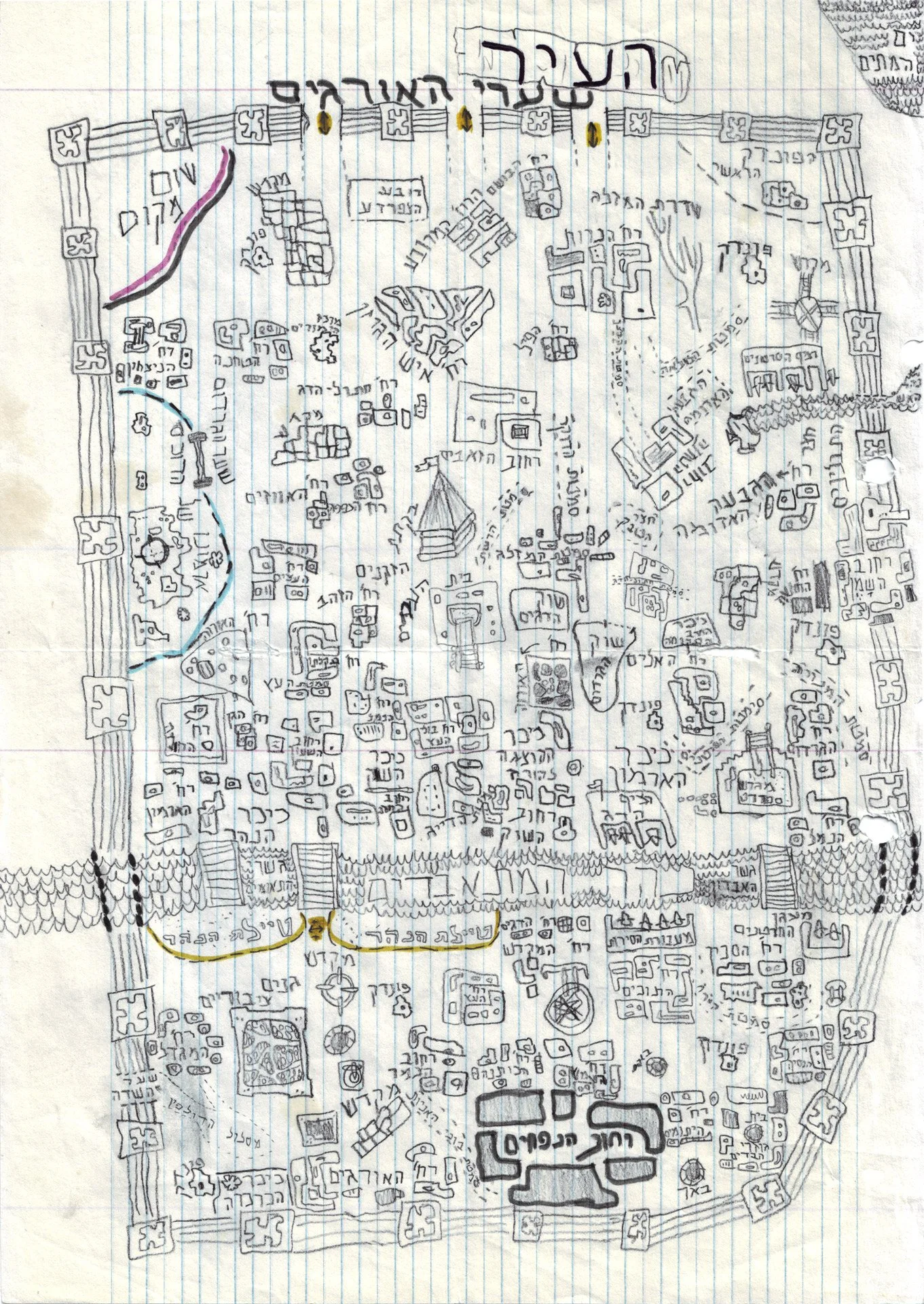
THE CITY, Rotem of Qiryat Gat, early 90's, Qiryat Gat, Pencil and marker on notebook paper
In the beginning of Eternal Pavilion, a young boy strolls through the ruins of the Decade Pavilion cinemahouse, in the development–town of Qiryat Gat. The encounter between the innocent eyes and the cinemahouse, now stripped of its machinery, sprouts a wild tree, from which ascends a dense overgrowth of branches and sub-branches, converging with into social, political, and cultural processes.
Rotem of Qiryat Gat recounts a revelation he had experienced as a child, which expressed itself as an obsession with death, something he forgot about, yet his parents reminded him that he kept asking them — when will he die, when will they die. He would constantly draw skeletons and skulls. From a young age, he would watch films that were considered unsuitable for children, but his parents permitted it: Rosemary's Baby, The Elephant Man, The Wall, Jaws, and others. Whenever he entered Qiryat Gat's video store, they would fetch the ladder from the back room. He would climb all the way up to the ceiling, to the horror film section and rearrange it according to what he had already seen, no one but him would touch it.
“The title — Eternal Pavilion, reverberates the names of ancient esoteric writings in Judaism (my mother’s name is Judith,) a vast universe I cautiously avoided, and during the creative process I was exposed to a tiny fraction of its fascinating richness. But above all, the greatest influence, the seed for the thought of creating this book, is without doubt the Aleppo Codex, residing within the damp and cool walls of the Shrine of the Book. What?! Lo and behold – all of a sudden I see for the first time the link between the Shrine of the Book (Heikhal HaSefer) – the place where my eyes opened wide when I first saw the verse ‘This is the Gate’ within the pages of the Codex, the Decade Pavilion cinemahouse (Heikhal HeAsor), and my book – Eternal Pavilion (Heikhal HaNetzach.)”
Rotem of Qiryat Gat, email message, February 18th 2015
We sail with RQG (Rotem of Qiryat Gat) across the horizon of ancient Hebrew influence, through the square letters which were born in the middle east and found their place among the drawn images, witnessing how cinema and television shaped the soft and fragile mind of Rotem – the child. We then realize that even the disintegration of a cinemahouse in the periphery is a decisive moment and that art can restore that which was lost. In our reading of the work, we should refer to a multilayered structure: Theology (expulsion from the Garden of Eden, death, the Aleppo Codex, his mother's name,) image (horror films, his documentary on the Decade Pavilion,) periphery consciousness (Qiryat Gat, the cinemahouse destruction) and Mizrahi Consciousness of third and fourth generation that emerged in the outskirts of Israel. Through these layers, we shall wander in our journey to the depths of the Eternal Pavilion.
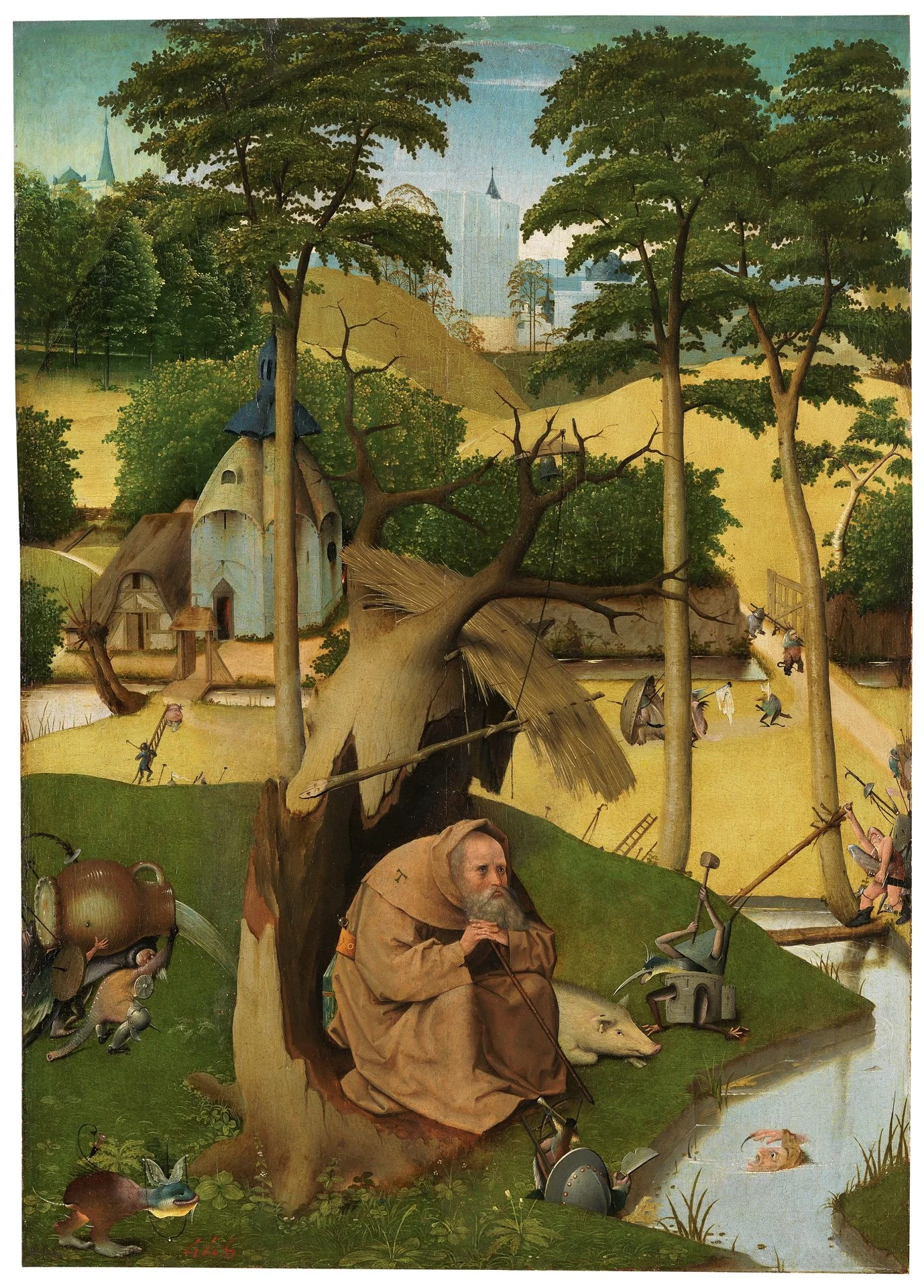
THE TEMPTATIONS OF SAINT ANTHONY, Hieronymus Bosch, 1510–1515
״As a child, I dreamed of becoming an archaeologist (I still do) and a garbageman. I don't know why, but the desire to be a garbageman and work with everything to do with waste, fascinated me. My love for archeology is evident in my drawings and other works. Archaeological excavation is converted into an excavation of consciousness, layers of history give way to the depths of the subconscious, the findings are then collected, cataloged, measured, deciphered, and ultimately stored in the archive.״
What if each of us employed an archaeologist to study their subconscious? We take for granted the notion that archaeology relies solely on physical excavation in the heart of the earth and sea for the study of ancient civilizations lost in time, yet human society consists of individuals and each individual is a society in itself. Everybody is worthy of an archaeological expedition that would dig and uncover the remains of their culture. Archaeology departs from its traditional role as an exact science, the drawings dissolve into dark raw matter that consists of a multitude of points, defying any definite form.
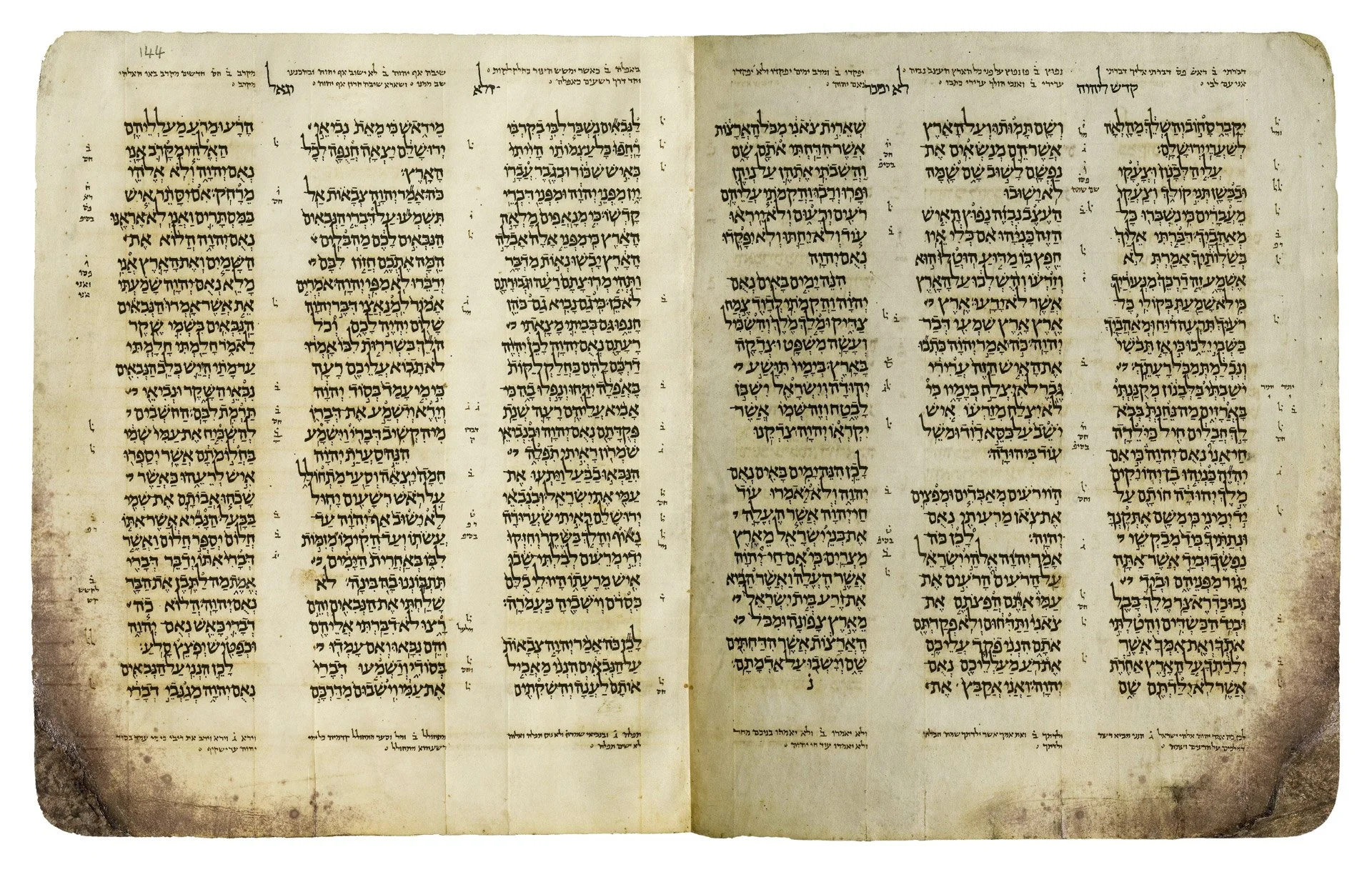
ALLEPO CODEX, circa 929, Jeremiah, Chapters 22–23
RQG is an archaeologist of his own subconscious. Instead of accepting monumental historical dictates, he offers a possibility for a unique history, one which would not be documented in official history books. We are invited to open the doors to the pavilions of consciousness and register the chronicles of the unknown.
Is Eternal Pavilion a symptom of the obsession with death? Can it serve as an elixir for our encounter with death? Definitely yes and definitely no since Eternal Pavilion is first and foremost a theological question. RQG provides his answer by diving into the abyss of the subconscious, salvaging precious stones, lost in the history of the self. Eternity lies within these forgotten gemstones.
Within the Eternal Pavilion of RQG, we find a correlation with Osiris’s Egyptian Eternal Pavilion. We may regard the viewer observing the works as the sacred Egyptian Scarabaeus, rummaging through the antiquities of the individual’s subconscious. RQG conjures up figures never before seen. He creates a private mythology through a taxonomy whose meaning we fail to grasp, and yet, its inherent order is evident.
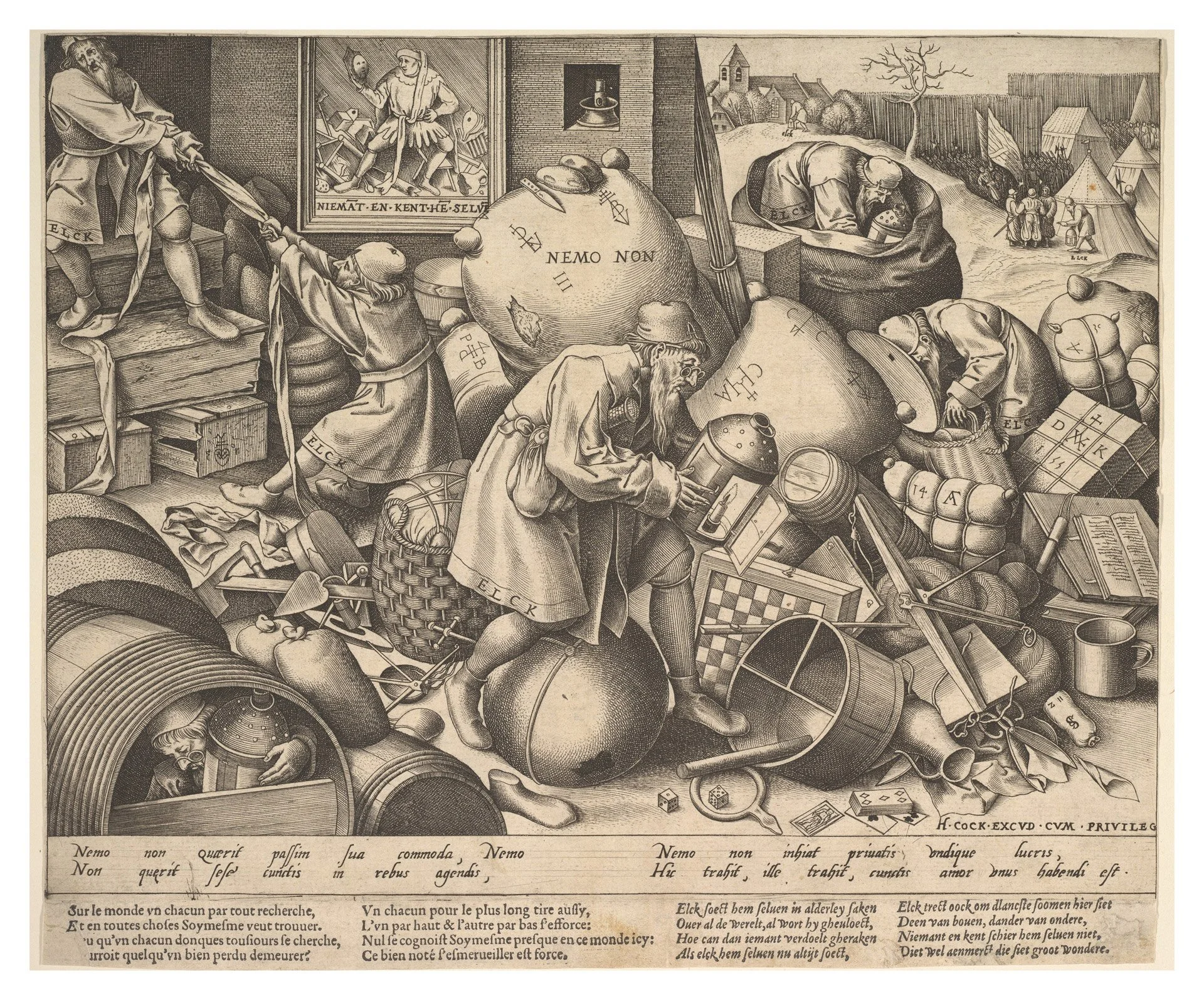
EVERYMAN, attributed to Pieter van der Heyden after Pieter Bruegel the Elder, circa 1558
It appears that the Eternal Pavilion is seeking to freeze the spirit of the times and render it timeless. A closer look reveals a slightly different newsreel. RQG incorporates Graffiti, miniature billboards that are visible throughout his work:
“Faggotts & Dykes Control the World” [ Drawing 60, Revelation, 2014 ]; “A land where all is play is a land of donkeys – Pinocchio” [ Drawing 61, Human Endeavor, 2014 ]; “Creation = Sin” [ Drawing 69, And Saw That tt was Good, 2014 ]. These phrases are not directed outwards at any external reality. Instead, they present an opportunity for inward reflection, into the crevices of the subconscious. We ought not dismiss them as mere campaign slogans, stretched across plastic banners in the streets, in order to watch the newsreel of the subconscious we must wear a different type of glasses. The scene revealed is a kind of hell, reminiscent to that of Hieronymus Bosch, set in an Israeli backdrop. The nerve lines in his work are pulsating, sometimes even raging, inconsistent with the surface plane of reality, his graffiti dwells where words dissolve into fragments of meaning, almost mocking the possibility of a clear statement. Additional textual layers can be identified:
COMICS
The combination of the drawn image and the written word yields the sense of comics. There’s motion, words, quotes, and even imaginary chapter names advancing the storyline.
DIARY
One can read the drawings as an intimate travelogue consisting of hidden feelings, thoughts and mundane concerns. For example, in the drawing ‘The Infinitely Subtle Forms of Fascism’ [ Drawing 12, The Infinitely Subtle Forms of Fascism, 2014 ], where he writes about his anxiety following a trip to Berlin.
MULTILNGUALISM
Writing in various languages – Hebrew, English, at times even broken German, as well as writing in personal, pseudo-fictional tongues – indicate that RQG refuses to be confined to the imagined national territory.
POETRY
Piecing together letters with diacritical signs, to create literary structures in the tradition of Israeli poet David Avidan, thus, lending a lyrical countenance to the characters. This homage is a contemporary continuation of the radical spirit of the Sixties.
TITLE
Oftentimes the title is present within the drawing.
Keys to the Eternal Pavilion
Entering the Eternal Pavilion means setting foot in an uncharted realm, we therefore require special keys to understand it:
In the Field of Dreams
The work is abundant with a myriad of subtle sensibilities and never-before-seen creatures, yet we may have encountered some of them in our dreams, nightmares, delirium and hallucinations. Still awake, we slip into subconsciousness, daydreaming, surrounded by heaps of vital metaphors stacked on top of each other, metaphor upon metaphor, upon metaphor – each one evokes reflection and contemplation, and when juxtaposed together, they conjure up another kind of thought. Let us take inventory of the first row in the drawing Characters [ Drawing 04, Characters, 2014 ], starting from the top right-corner: a. A flat-headed bunny sitting on a lampshade on which a carrot is placed; b. A pencil-nosed fox sitting on a vase, or cloud, a Doric column beneath it; c. A mouse standing on a rock, tied to some sort of stingray, seated on a worm, bird or whale; d. A bulldog in a sphinx position on some kind of armature, a potted plant or a bouquet popping out of its rear-end. In this field of dreams, the established order is unraveled and melts away, we are then forced to restate our assumptions.
From Adam/Human to Thing/Speech and back
In their lexical definition, 'Devārīm' (Things) are “A general name for inanimate objects, not precisely designated.” In the Bible, the word 'Devarim' (Speech) first appears in Genesis 11:1 “And the whole earth was of one language, and of one speech.” In its biblical context, the word 'Devarim' appears in plural form, denoting quantity, multitude, and, perhaps even movement. While ‘One Language’ is monolithic, ‘One Speech’ offers a movement surrounding the One. At times, the drawings evolve towards a movement, foretelling the appearance of characters [ Drawing 03, Death, 2014 ], and sometimes they remain in an inanimate state of objects without form or name [ Drawing 47, We Want Freedom, 2014 ]. Those are the things that we don't know how to categorize, prior to the deconstruction of the chromosome, before taking on the burden of responsibility. It is in this very moment that we are forced to pause and reflect.
Beyond Good & Evil
Many of the drawings are populated by Chimaeras, hybrids referencing Medieval Art, as in the works of Hieronymus Bosch and Pieter Brueghel the Elder. However, Contrary to their work, primarily founded on a clear perception of morality (Heaven and Hell, the Seven Deadly Sins), here we find ourselves entangled in an intricate arabesque interlace. Nevertheless, certain drawings display a distinct conceptual-political-moral outlook. On the one hand, a critique on nationalism [ Drawing 08, Sorry to Have Wasted Your Time…, 2014 ], and on the other hand, a fascination with the Sermon on the Mount [ Drawing 19, Mount Sinai, 2015 ].
Elements: Religion, creativity, and Abyss
Let us glance at the drawing ‘Blossom’ [ Drawing 39, Blossom, 2015 ]: A figure of a boy planted in a flowerpot, a thin tree trunk stems from its trimmed head, branching upwards. Imaginary foliage blossoms at the treetop, a habitat to some vegetative lifeforms. The boy raises his hand in a gesture alluding to Buddha. Several elements may be identified in the drawing: Religion (Buddhist gesture,) Faith in Creativity (from the boy's fevered mind, imagination is thriving and running wild,) Abyss & Melancholy (the boy is planted as an object in the flowerpot, his head trimmed). These are essential elements for understanding identity construction processes in RQG's body of work.
Betwixt the Microscopic and Telescopic
An interesting tension exists between the long shot and the close-up. RQG creates the intensity of the drama stretching between the specific and the general as, for example, in the drawing 'Creatures' [ Drawing 65, Creatures, 2014 ]. The individual details beseech us to zoom in and examine the surface texture, while the drawing as a whole beckons us to zoom out and grasp the index in its entirety. It feels as though we were gazing into the portal of the subconscious with both a microscope and a telescope at the same time.
The Organism
An overview of the whole œuvre reveals a biology of an organism. Oblivious to itself, this organism is enveloped in a rich abundance of cells, out of which a living and breathing coral reef is formed. All those moments that were suppressed throughout life have now developed their own autarkic world – a microcosm with an independent set of inherent rules, existing only within the confines of the drawing. It is a parallel reality in which the imagined creates the actual ■
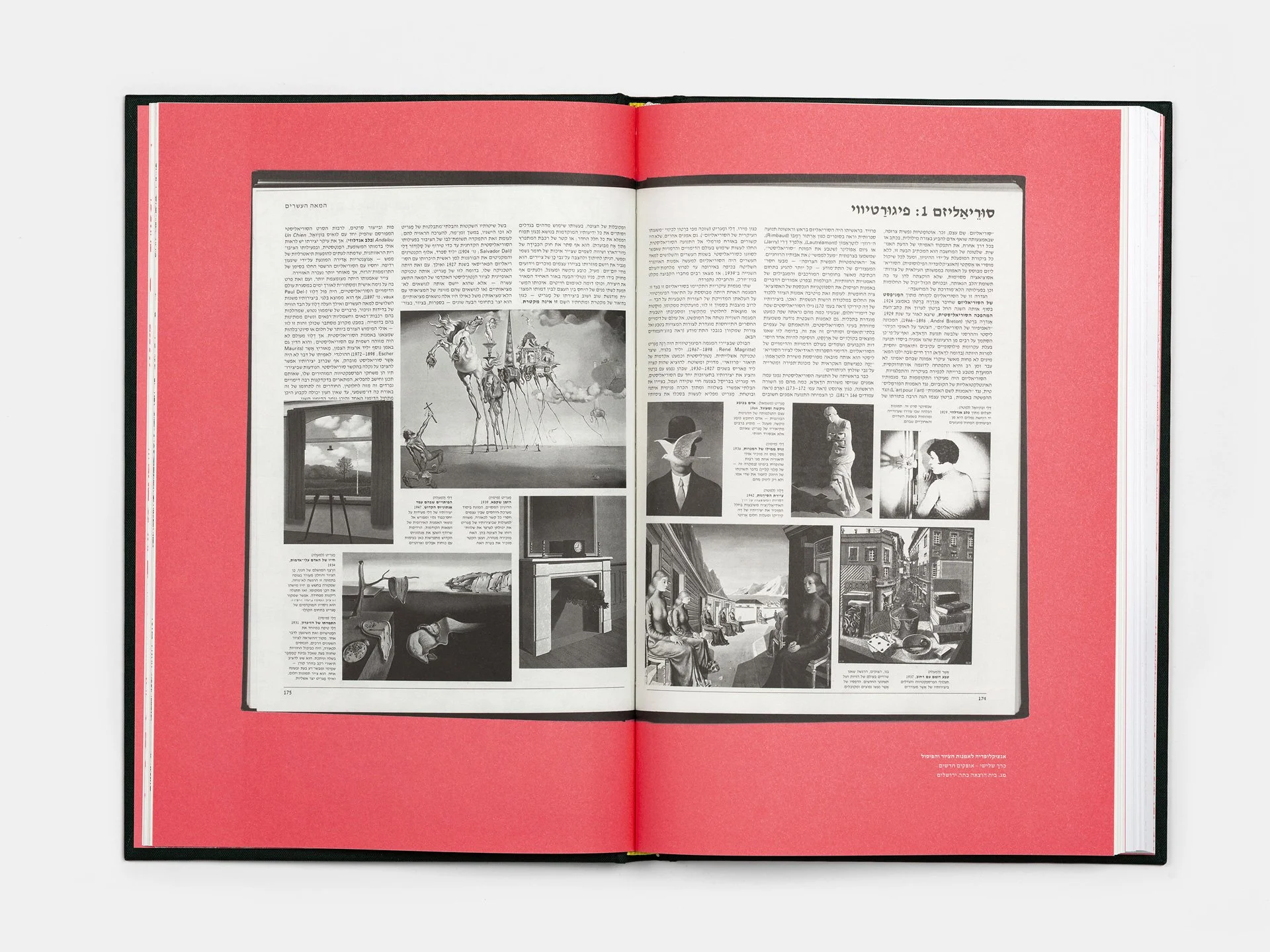
Art Encyclopedia of Painting & Sculpture, Vol. 3 – New Horizons, 1982, Keter publishing house, Jerusalem
Courtesy of the artist
Tags: Rotem Najar, rotem of qiryat gat, Eternal Pavilion, art, drawing, Hebrew, poetry, archæology