Mati Shemoelof in Conversation with the artist Rotem of Qiryat Gat
Berlin, 9.2.2015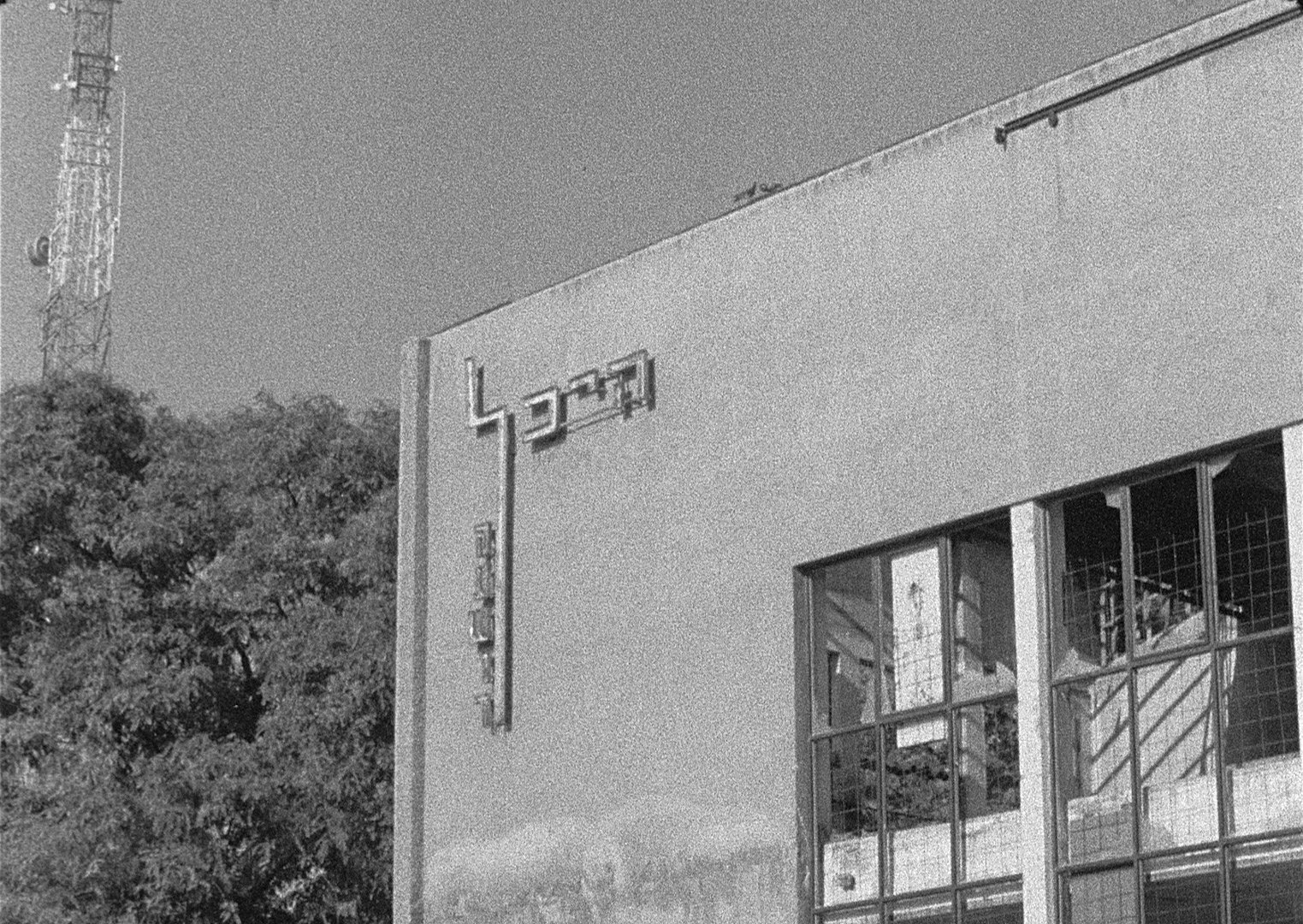
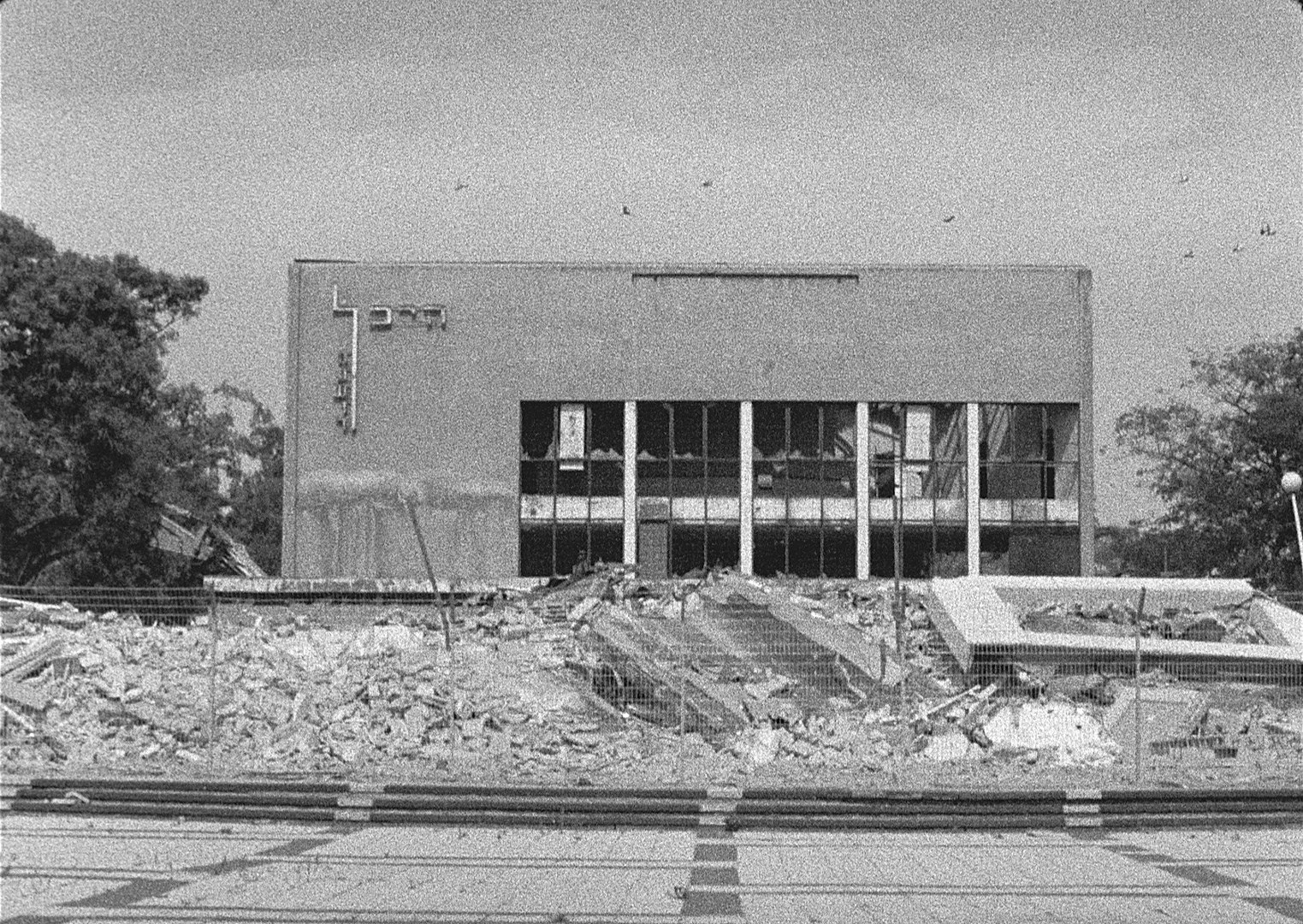
DECADE PAVILION, 2009, 16mm film, Qiryat Gat
Translation from Hebrew by Ada Lewinski, TransLangue
Mati: When did you start drawing?
Rotem: I started drawing at the age of four, in kindergarten. We had several art books at home, at a very young age I would study the works of Dalí and various masterpieces which appeared as miniature reproductions. I didn’t understand how such fine detail could be achieved, I loved miniatures and wished to create miniscule things, I would try and sharpen my pencil as much as I could to achieve subtle fine lines, I didn't know such unique techniques as etching existed.
M: If I were to see works from that time...
R: Not much survived. At sixth grade, I decided I’m all grown-up – I was going to stop watching cartoons, and got rid of all my drawings, hundreds of pages crammed in eight drawers, I threw them all away, very few drawings remain where a possible link may be found. Between the fourth and sixth grades I experienced some sort of revelation…
M: Tell me about the revelation.
R: I used to be fixated on death when I was little, really little. It lasted a short while and was soon over. Something I forgot about, but my parents reminded me. I used to ask them “when are you going to die?,” when are we going to die?,” “when am I going to die?” Things related to death, I was constantly drawing lots of skeletons and skulls, highly detailed things only a few drawings from that period had survived.
I also drew inspiration from animated TV series and things like that: Once Upon a Time... Man, He-Man and the Masters of the Universe, anything that aired on Channel One. Certain films definitely affected my consciousness, since I used to watch them almost every day from a very early age. Films considered unsuitable for children, yet my parents let me watch them anyway. Films such as Rosemary’s Baby, The Elephant Man, The Wall, Jaws. There was a video store in Qiryat Gat, whenever I went in, they always knew to fetch the ladder from the back room. I used to climb up to the ceiling, to the top shelf of the horror films section and rearrange it according to what I had already seen, no one else touched it. As a child, I loved horror films. All those things came together and influenced me.
M: How did you select what would be included in the Eternal Pavilion?
R: The book is the result of a process not entirely conscious. I remember one thing – my girlfriend broke up with me on my birthday. As she was breaking up with me, she said “It seems to me that we’re going nowhere,” she didn't say “it seems to me that we are not going anywhere,” meaning we are going somewhere, except this place is a kind of nowhere… I took a liking to that sentence, what she said resonated within me. Feeling a bit down, I returned to my room at my parents’ house and created the first drawing. Several organisms, alphabetically indexed, making no logical sense. I named the work ‘Going Nowhere’ [ Drawing 71, Going Nowhere, 2014 ]. On the other side of the sketchbook I wrote – Eternal Pavilion. In a rare documentary excerpt, artist Jean-Michel Basquiat said, “I think I have to learn more just not to work around what surrounds me and just work with what I think, I guess. I shouldn’t let what’s around me affect my work at all, I think. just to work on what I know I work on”. I loved that line and said to myself, I'm going to do something with a similar intent, to look inward within myself. Another principle that had slowly evolved, was not to give up on pages I would usually skip and leave unfinished, and instead, continue working on them to mine the blessing and the good.
M: Your dialogue with Hebrew and Egyptian scriptures is prominent. Those who delve into your work know it's a part of who you are, and you transform it into an artistic tool. Do you feel your art bears theological meaning?
R: I think it does, since I was a child my favourite book has been the Bible, I always loved reading this book.
M: But the Bible has Black & White, Good & Evil, the works of Hieronymus Bosch have Heaven & Hell, yet your book has no morality, those who search for Good & Evil might get lost. Perhaps your morality is related to the post-modern perplexity?
R: I always perceive the Bible as such a complex composition… In essence, it is a collection of words on a page, yet it engages people, commanding them to do certain things, and this is a high degree of genius which one may choose how to address, it may be viewed as a form of insanity. When the Bible says Thou Shalt / Thou Shalt Not, I regard it as the genuineness of people who plotted and schemed to devise those words in an authoritative manner to make them sound divine. I love the idea of a book where, in the author’s absence, the work is that which remains, I like it when the book speaks to the reader, suddenly emerging as a living thing, even though it is only you and sheets of paper, it intrigues me.
M: The words in your works leave us in the dark, when it comes to comprehension of the image, you don't tell a complete story. Please elaborate on the connection between word and drawing.
R: The commandment “Thou shalt not make unto thee any graven image” is a theme I often deal with. The arrangement of words alongside abstract images, lacking tangible meaning, allows me to draw without having to create a particular figure, to remain somewhere in-between.
There is also the aspect of diary-like writing. I tend to begin the drawing at the top of the page, and work from right to left as in Hebrew writing. The idea is that both the words and the image have equal significance – sometimes, a word appears as the textual equivalent of an image, and the drawn image can be read as text, both are registered using the same pen, the same line.
Another element is the influence of Japanese prints; calligraphy becomes part of the composition, even those who don’t understand Japanese can appreciate the typography from an aesthetic point of view. Sometimes, the words in my drawings are unintelligible, serving as signifiers of words. The text is an integral part of the form.
M: Do you understand your drawings?
R: To a certain extent. I find it difficult to see them for what they really are. It dawns on me from time to time, at certain moments. I can figure out the meaning and context behind them that other people cannot know. I’m aware of having inserted hidden messages, sometimes I forget and try to decipher and recollect, knowing there was something there, but unable to remember what it was. There are certain secrets, if somebody were to study my drawings, they would find links to other works, a personal mythology of sorts.
M: How do you choose between works with empty space and ones overflowing with detail?
R: In fact, I am drawn to minimalism, in many respects it’s something I aspire to. On the other hand, there is that minimalism which becomes decorative, serving a beauty of whiteness, I don't like that. I have this constant battle between minimalism and Horror Vacui. Instances where minimalism resides are of good virtue – those which prevailed and overcame hardships, struggles and demons, and made it to a higher level, like a Bonus Stage. I feel this is a minimalism that had earned its right to exist, not merely an elitist decoration to be hung in the living room. It also stems from a Zen Buddhist origin.
M: I once visited your exhibition and saw a piece that reminded me of Robert Crumb.
R: The Turning of the Pyramids.
M: Somehow, you brushed off all those influences and found your own voice – less clutter, colors, or the attempt to create comics, and more of that place which I refer to as paradoxical, a marginal statement, which recoils quick politicization, and tends to deconstruct rather than construct.
R: You touched upon the exact point of The Turning of the Pyramids, which led to the change you describe. Upon completion of that piece, following six months of day-to-day work, I was still deeply immersed in the obsessive, the intense, everything had to be exploding with detail, extremely grotesque, filled with provocative messages, and the moment I was confronted with what I had created, I immediately felt a kind of peak or fulfilment. Now, I can set that thing aside and move on to somewhat more peaceful, complete things. I’m not saying I got there, but that was the general direction.
M: Which pen do you use?
R: Faber-Castell’s technical drawing pen, 0.1 mm., a pen originally intended for drafting and architecture. It is refillable, and lasts long if you take good care of it. Its uniqueness is in its line – a uniform, consistent, clean and precise line.
M: Why did you focus on this particular pen?
R: I received the pen when I was fifteen as a gift from my good friend Nissim Kalderon. The first drawings I did were studies of paintings by Francisco de Goya. When I first started, my line was much wilder, pencil-like, perhaps that sensitivity got a hold of me. I felt I had found my instrument. It was the best pen for expressing the subtlety and line I had always searched for, it eventually possessed me, by now, it had already become something I’m trying to shake off. The technique I wish to practice is engraving, I have yet to develop a method that enables me to employ this technique on a daily basis.
M: What kind of paper do you draw on?
R: I mostly draw in Zap Book sketchbooks. The paper is produced for over a century near waterfalls in France. An innocent-looking sketchbook, the paper feels like draft paper, the kind I used to draw on in kindergarten. I always loved that kindergarten paper – not the bright and bleached office paper, but the pleasant draft papers, which let me feel I could flow without the threat of the empty page.
M: There's an intimate quality to all your sketchbooks – the way you view the world, your identity, small details. Where do you get the courage to share these things with people you don't know?
R: My works are opposed to mass advertising and billboards, I draw in small sketchbooks and papers, in a manner seemingly inaccessible – things are so tiny that the viewer has to make a choice and delve into the work, it has to be a conscious decision to take that step, and then it is possible to discover the most personal things, but first, you must want to do it. I challenge the viewer to get interested. Artists have a responsibility to protect freedom of speech, to defend and express it. I don't mean to provoke, I mean to be honest, and say what I feel in that very moment, even if I might disapprove later on. Looking back on certain things makes me think "Oh my, what was I going through…," yet I don't renounce them, at the time they felt true.
M: In your work, many creatures are emerging from other creatures, devouring each other, melting into one another, a Hieronymus Bosch hell set in an Israeli-diasporic backdrop. What do these creatures have to say? If you were to give them a microphone, what would they say?
R: The creatures are not overtly smiley - if you stick a smile on a character, it would forever remain with that smile and would eventually suffer, no one wants to smile all the time. Suppose you were forced to smile for the rest of your life, that would be torture. On the other hand, the opposite extreme of being stuck with a terrified look isn’t the most pleasant feeling in the world. It's something I have been contemplating lately, I consider giving the characters a reserved smile, similar to that of Raphael's La Fornarina where insanity and joy coexist in the background, this precisely is that elusive place, the fine line in-between.
M: You speak of your creations as if it is you who has power over them, yet I feel they speak more of you than you of them. Are you really the one making decisions for them, or they for you?
R: The question of the conscious and subconscious is a complicated matter. When I create, the process is not entirely conscious. The creatures are born of themselves, I just try not to interfere and let them be born. Usually, once I have completed the drawings, I set them aside. When revisiting them, after a long period of time, I realize that I wasn’t really aware of my actions, but was documenting the state I was in at the time.
M: All the works originate from your inner mythology when, all of a sudden, your father appears – the only figure that is realistically rendered, thus disrupting the unity of time & place.
R: This drawing [ Drawing 37, Good Father Sleeping, 2015 ] is what binds the sheer hallucination with reality, we may be thinking – perhaps this is the dream of the person sleeping there. It provides us with an anchor, so we’re not left suspended in midair.
M: What does the future hold for your sketchbooks?
R: I hope they would travel far, and that someday, when I'm not around, people would be interested in them.
M: What do you see ten years from now?
R: I see a family.
I see a loving woman.
I see a boy, a girl, two kids.
M: That's it, I’m done.
R: Cool, no further questions ■
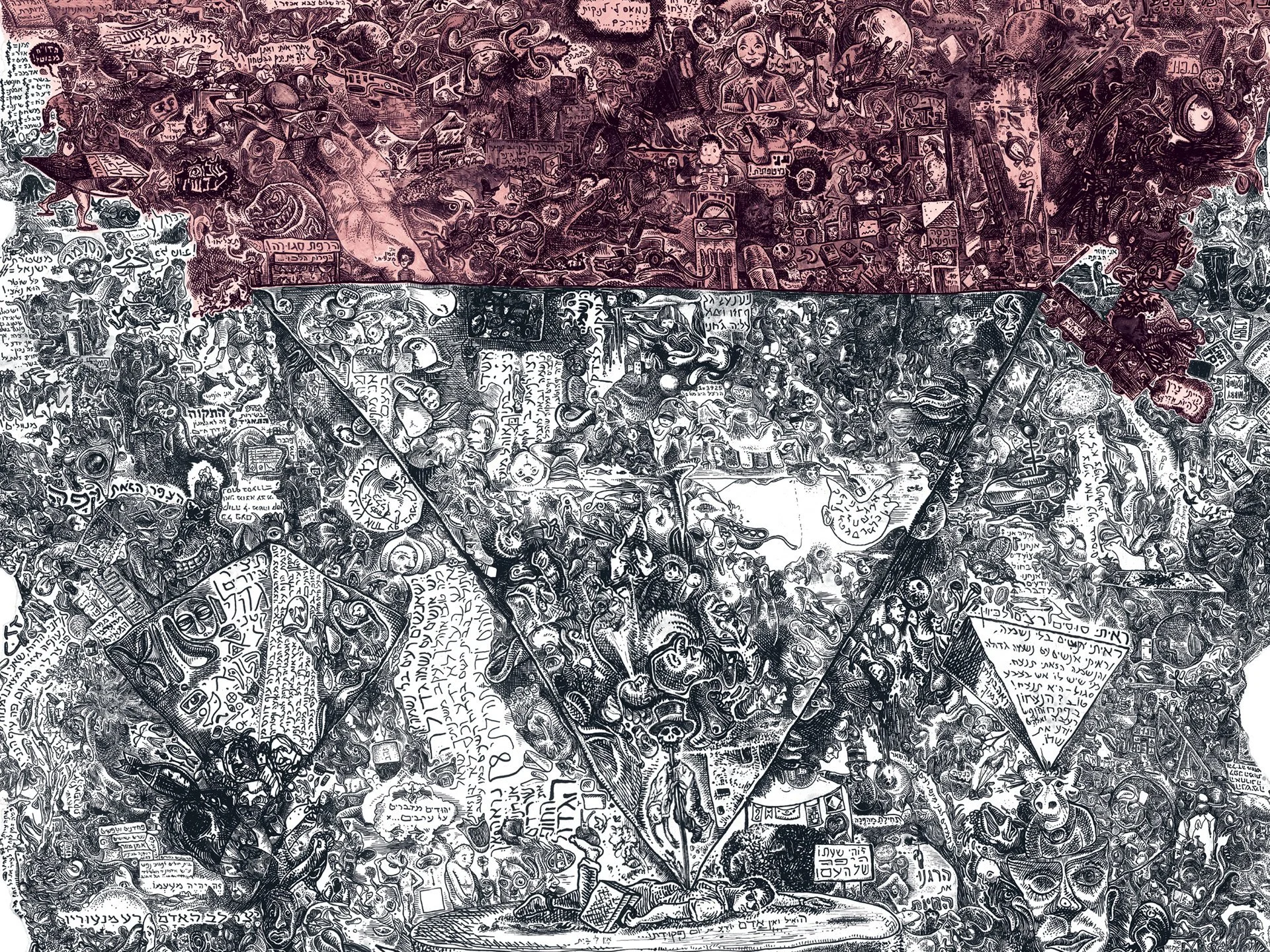
THE TURNING OF THE PYRAMIDS (detail), Rotem of Qiryat Gat, 2012, mixed technique on found rag paper
Courtesy of the artist
Tags: Rotem Najar, rotem of qiryat gat, Eternal Pavilion, art, drawing, Hebrew