Mati Shemoelof in Berlin: “It Is Also Okay to Know When to Step Aside”
First published in Germany on 28 November 2017 on Spitz Magazine.
Interview by Gadi Goldberg.
Mati Shemoelof in Berlin: “It Is Also Okay to Know When to Step Aside”
An interview with Mati Shemoelof by translator and writer Gadi Goldberg, published in November 2017 around the Berlin launch of Shemoelof’s poetry collection Ivrit MiHutz Le’everim HaMetukim (Hebrew Outside the Sweet Organs). The conversation explores migration, Hebrew as a minority language, Mizrahi identity, longing, diaspora, refugees, fatherhood and Shemoelof’s changing relationship with political activism.
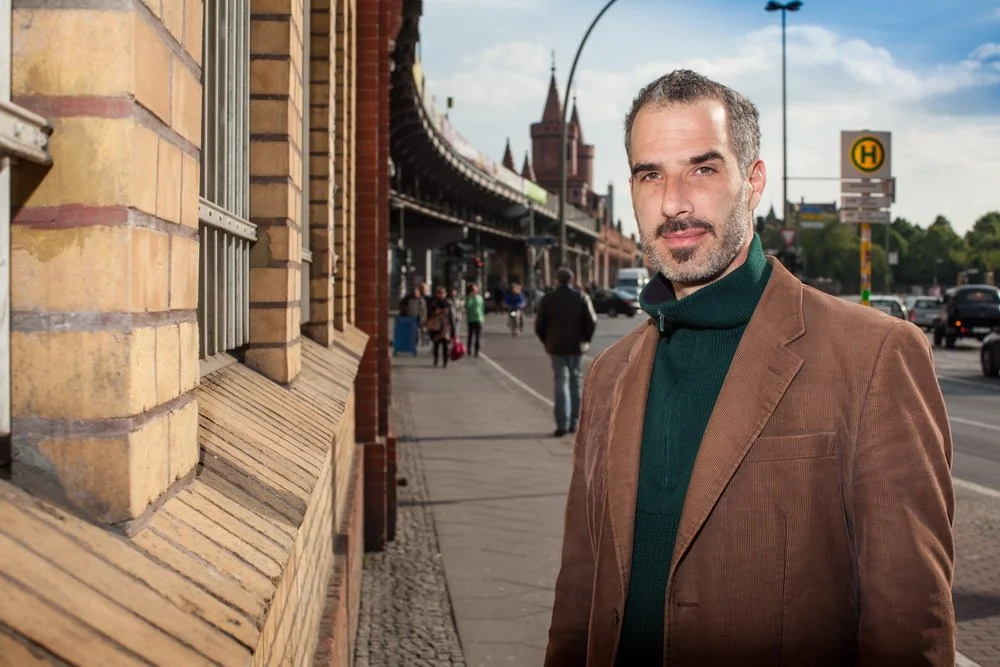
Photo - Cfir Harbi. 2014.
"Hebrew Outside Its Sweet organs": Interview with Mati Shemoelof
By Gadi Goldberg • 28.11.2017
The long winters, age, distance, the soul's aches: life itself has shifted Shemoelof from social protest and Mizrahi discourse toward realms of melancholy and longing. The translator Gadi Goldberg interviewed him on the occasion of the Berlin launch of his new book, Hebrew Outside Its Sweet Organs.
About four years after moving to Germany, Mati Shemoelof (45) is publishing his sixth poetry book, Hebrew Outside Its Sweet Organs, the first body of work written entirely here in Berlin. This is also a central theme of the book, and it seems a lot of pain is tied to it, a lot of mourning. "No one prepared me for standing in the position of the immigrant," says Shemoelof. "I think there is a lot of creativity in this position, but in my case there is also melancholy. Maybe it's the long winters, maybe it's the history of the place, maybe it's age, distance, my soul, or maybe it's all of it together."
Shemoelof has already managed to put down some roots in Berlin: he married the German journalist Charlotte Misselwitz, and a few months ago the couple had their first daughter. Even so, the book is full of poems of longing for people and places in Israel. In his view, "these poems of longing are actually a kind of reconciliation with the place."
The book is called Hebrew Outside Its Sweet Organs. Does writing Hebrew in Berlin feel to you like writing "from the outside"? Do you think Hebrew is a language inseparably tied to the State of Israel?
In parting from the sweet orgnasof Hebrew, I'm referring to Hebrew turning from a majority language into a minority language. This language conducts a dialogue with the other language and its values. Like in the poem:
Where Is Abroad
I remember waiting for my friends to come back
from abroad, because I didn't believe there was anything beyond this land,
and suddenly, I'm the one living outside.
But I live in a land, in Germany,
and in a foreign land there is no such word as "abroad."
People roll freely from outside to outside,
from land to land, from language to language,
they wake up, the wrong people
in the wrong
era
The longing in the book isn't only for Israel; it's also for the places your family came from, for Aleppo, for Baghdad. How do you explain the way longing for Hebrew mixes with longing for those places?
The philosopher Jacques Derrida once said: "I speak only one language, and it is not mine." Twelve years of schooling distanced me from the language, the culture and the Syrian, Persian, Iraqi and Baghdadi world. But memory is a living sorrow, even of places you've never visited. There's one poem that I write in German-Arabic-Hebrew-English, "A Man Among Judendichter," and another in which I write in Aramaic, "Here They Come," and through that you can slowly hear the diasporic-exilic-Talmudic language taking shape here. In the past, every Jew had at least three languages: Hebrew, the language of the place, and a third one. Now I feel these are being rebuilt inside me.
The book also has poems about the refugees coming to Europe. What's the difference for you between migration like yours and their refugeehood?
The refugees coming to Europe have nothing. They have nowhere to return to, no suitcases except their own skin. I arrived with a 23-kilo suitcase, and I have somewhere to return to. The whole world rejects them, while I could choose where to go. In other words, I have privileges. At the same time, my arrival here raises the question of Jewish history: how many Jews were once part of this place, and to what extent history can truly correct itself. The refugees remind us that history repeats itself. They knock on the gates of the world and demand to be recognized as human beings like all of humanity, but many doors are closing and they wander from place to place, and in response to their arrival we see the racist right-wing party entering the German parliament.
Speaking of privileges: Mizrahi discourse and the discourse of privilege (if we may call it that for a moment) are almost completely absent from the book. How do you explain that? Have you abandoned this position? Or did something in your status here change it, marriage to a local woman, parenthood?
The Mizrahi struggle and the political activity continue, like a torch relay from generation to generation. I will remain loyal to social protest and Mizrahi discourse until the day I die, but I know it's also fine to know when to step aside. Specifically, the poem "Milk," the poem "Here They Come" and others are, in my view, very political. This untitled poem explains it better:
We fled because there was no point in fighting bloodthirsty readers any longer,
we fled because there's no point in struggling for forty
years to shed the song of
our white skin,
we fled because we were tired of expounding hope,
we fled because we knew nothing was waiting for us,
but precisely within that nothing
there is a great promise
In the context of Mizrahi discourse, I only recently wrote an article about the Iraqi-Israeli poet Amira Hess and also about the poet Roni Somek; about the artist's book of the artist Rotem from Kiryat Gat; and I'm editing a book of essays that gathers all my social-Mizrahi writing of the past decade.
If I surrender to your point of view, I'll say that for almost a decade I wrote exhaustively around important points, like a miner in a particular mine who has exhausted the ore. Now, having moved to live in the tunnels between Berlin and Haifa, I'm digging in a mine of poems written from here and not from there. They include everything we've discussed so far: pain, writing from the outside, the language of longing, writing in a minority language, what Jewish-Arab culture is in Europe, refugeehood, distance from local politics and more.
What has really changed in your attitude toward politics and society in Germany in general and Berlin in particular? In a previous interview, a few months after you moved to the city, you said regarding the fight against construction at Tempelhof: "I think they won't manage to stop the initiative. Also because I'm starting to get to know the left here…" Do you feel you now know local society better? In hindsight, do you think it might have been better to wait before interpreting German politics?
Don't ask. I had to eat my hat, and it wasn't pleasant. I was wrong at other historical junctions too. Back then I wrote a thesis on the connection between Malcolm X and Spike Lee, and I didn't believe a Black American president could rise. The day before yesterday, Galei Tzahal [Israeli army radio] asked me to speak about a certain issue in German politics, and indeed I passed it on to someone who is an expert in it. But the need to interpret the world is not rational.
How much has new fatherhood changed your poetry? In this book it may not yet be fully expressed, since most of the poems were presumably written before your daughter's birth, but do you feel it affects your poetry?
The pregnancy is between the lines. Like the birth of the ability to express longing. Before that, I fought monsters. Now I try to formulate clearly the place where I dissolve into a liquid of yearning and craving, which I hope seeps onward into the readers' thirst.
As mentioned, the book has a lot of longing for Israel and for the Hebrew language. How do you see your future in Berlin? Do you think you've succeeded, or will succeed, in integrating into the local space? Into the local job market?
The future is unknown. If you had met me a few years ago and told me this was what would happen, I wouldn't have believed it. I'd like to believe that new things will happen that I won't believe in. I'm not busy trying to integrate, but it's happening on its own. Just recently I took part in a festival of radical Jewish culture organized by the poet Max Czollek at the Gorki Theater, and also, as part of Ars Poetica, we were invited for the first time to perform outside Israel, both with the Poetic Hafla and at the Jewish Museum Berlin, and the next day I flew to lecture to the Jewish community in Vienna. I'm invited to events as part of German society, but I'm looking to keep creating in Hebrew. I don't think I could express myself in another language, though I'm conducting secret experiments in new poems.
A few translation notes:
"Sweet Organs" (evarim) is my literal rendering of "איבריה המתוקים." The word means body parts or organs, and it's a play on the Hebrew expression for a language's or body's "members." You could also render the title as "Hebrew Beyond Its Sweet Organs."
"Judendichter" is left in German, as in the original title.
The names Amira Hess, Roni Somek and Rotem are transliterated from the Hebrew, so please check their established English spellings.
The Galei Tzahal remark (Israeli army radio) is kept as is, with a brief gloss.
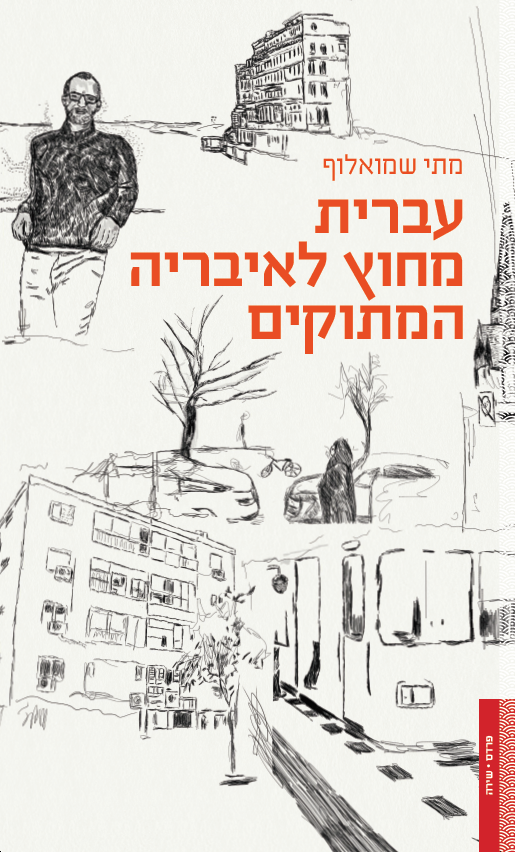
כריכת הספר החדש (רישום: שחר סריג)
Category: Press & Interviews
Tags
מתי שמואלוף, גדי גולדברג, עברית מחוץ לאיבריה המתוקים, שירה עברית, שירה ישראלית, ברלין, Berlin, הגירה, דיאספורה, זהות מזרחית, מזרחיות, יהדות עיראק, יהדות סוריה, יהדות איראן, עברית בברלין, ספרות עברית, משוררים ישראלים, Hebrew Poetry, Mizrahi Identity, Diaspora, Migration, Berlin Literature, Jewish-Arab Identity
Related links
Tags
Mati Shemoelof, Gadi Goldberg, Hebrew Outside Its Sweet Organs, Hebrew Poetry, Hebrew Literature, Israeli Poetry, Mizrahi Identity, Mizrahi Literature, Berlin, Berlin Literature, Hebrew in Berlin, Migration, Diaspora, Israeli Diaspora, Jewish-Arab Identity, Jewish-Arab Literature, Haifa, Baghdad, Aleppo, Fatherhood, Contemporary Poetry, German Literature, Hebrew Language