Mizrahi Identity, Arab-Jewish Heritage and Itamar Ben-Gvir
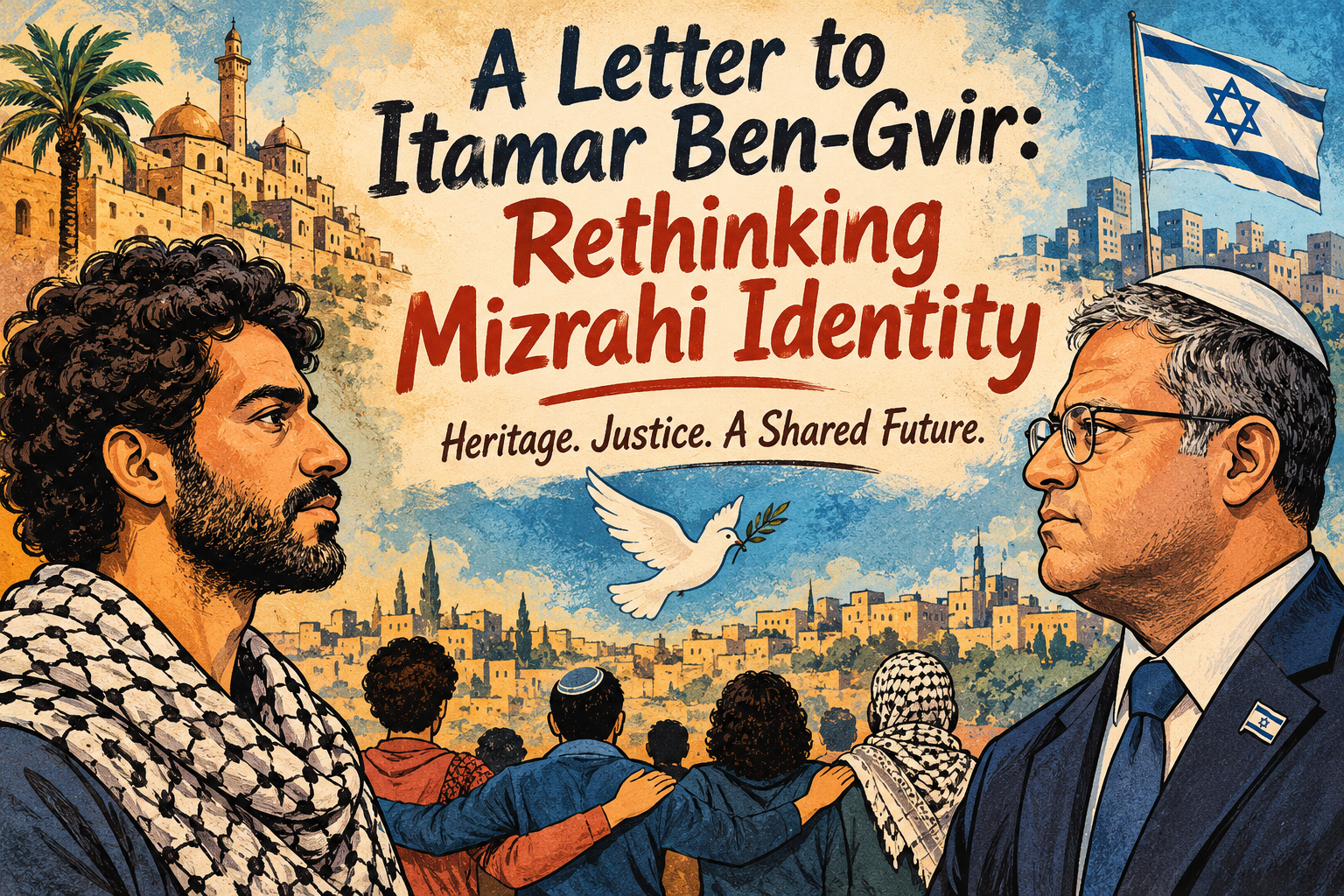
What does it mean to be Mizrahi today? In this personal letter to Itamar Ben-Gvir, Mati Shemoelof explores the politics of Mizrahi identity, his Kurdish and Iraqi Jewish heritage, and the difference between cultural representation and social justice. Writing from Berlin, he argues for an Arab-Jewish identity rooted in shared history, equality and a future beyond domination.
“Mizrahi” was originally a derogatory term used to describe Jews who emigrated from Arab countries to Israel. European Jews, known as Ashkenazim (Ashkenaz is the term that use to describe the land north of the Rein), often saw themselves as superior to Mizrahi Jews, believing that Arab culture and history could not be compared to that of Europe.
However, new Mizrahi generations emerged and reclaimed Mizrahi identity as something positive. They began to demand social justice and multicultural recognition within Israeli society and politics, and to advocate for peace with the Arab world and with Palestine.
Over the past twenty years, an active debate has developed around this ethnic divide between Mizrahim and Ashkenazim. This discussion reveals broader questions of class, political orientation, and Israeli identity. Today, more than half of Israel’s Jewish population is of Mizrahi origin. But until today there wasn’t an Israeli prime minister from the Mizrahi origin. Some Mizrahim identify themselves as “Arab-Jews” or as Sephardim (Jews whose ancestors were expelled from Spain in 1492).
Itamar Ben-Gvir and I were both born into the third generation of Mizrahi Jews in Israel. I decided to write him a letter reflecting on how Mizrahi culture should be defined today.
PM Itamar Ben Gvir,
We met for the first time in Ashkelon. I was standing alone with a sign that read: “Mordechai Vanunu, you are my Mizrahi hero,” on the day he was released after 19 years in prison, much of it in solitary confinement. You were among those who came with the crowd—shouting, cursing, threatening. You threw eggs on us and laughed. And I was on the other side, the only Mizrahi activist, part of the majority Ashkenazy radical left. I still think that it was important that Vanunu exposed the nuclear secrets because the path to a political solution in the Middle East also goes through de-escalating the nuclear arms race. Two Mizrahi men, standing on opposite sides of the same moment.
Since then, we have walked in opposite directions. You moved from the margins into the very center of power, carrying with you an ideology shaped by Rabbi Meir Kahane—an ideology that I see as rooted in exclusion, fear, and Jewish supremacy. I, too, began at the margins, but my path led me into the world of culture and poetry. For years, I tried to politicize Hebrew literature, to bring forward Mizrahi (as an Arab-Jew) and Palestinian voices, to insist on building an alternative to the hegemonic Zionist European story that Israel tells herself. Eventually, I left. I have lived outside of Israel for more than a decade now. From Berlin, I watch from a distance, having given up whatever position I once held within the cultural center. I could not reconcile myself with the ongoing occupation, nor with the persistent erasure of my own cultural history.
We share, in different ways, a biography marked by the neglect of Arab-Jewish identity. But what we have done with that inheritance is the important question I want to touch within this letter.
Some time ago, at an event at the Jewish Museum in Berlin, where I spoke about the misrepresentation of Mizrahi, Sephardi and Arab-Jewish histories in Germany, I met a non Jewish Kurdish activist. He spoke to me about the fragmentation of Kurdish life across borders, about the struggle for recognition and statehood. Then he mentioned you as an example. He told me that when you met, you spoke immediately about your Kurdish and Iraqi roots, and that he saw in your political rise a form of representation—proof that a Kurdish Jew could reach the highest levels of power in Israel.
I listened, and I was struck not by pride, but by dissonance. Because when I think of your politics, I do not see representation. I see the instrumentalization of identity. I see Mizrahi and Kurdish heritage being mobilized to legitimize policies that deepen violence—Genocide against Palestinians in Gaza and Ethnic Cleansing in the West Bank, torture against prisoners, and repression as a tool against the very idea of equality. Where he saw recognition, I saw what I can only call a “Mizrahi wash”: the use of marginalized identity as a shield for power. Not only that, but to my Kurdish friend I explained the idea of the “Kurdish wash” that Israel is trying to make alliances with the Kurds, in order to silence the global outcry to how it treats the Palestinians. I mean how can we empower one group of minorities that suffers on going persecution and ignore that other?
This is where our paths diverge most sharply. My own connection to Kurdish and Iraqi Jewish history tells a different story. My grandfather was a Kurdish Jewish communist in Baghdad. The history I inherited is not one of purity or supremacy, but of entanglement—of Jews as part of the fabric of the Arab world, contributing to its culture, its modernity, its political struggles. Yes, there was persecution. Yes, there was displacement. But there was also a shared life that cannot be reduced to a single narrative of a national identity.
To be an Arab-Jew, for me, is not to seek domination, but to insist on complexity. It is to refuse the idea that safety for Jews must come at the expense of another people (I mean to create “safety zones” inside of Gaza, Lebanon, Syria etc.). It is to imagine a political future grounded in equality, in partnership, in the difficult work of ending the Palestinian occupation.
This is why I write to you—not because I believe I can change your mind, but because I want to articulate another possibility. Not only to you, but also to those, like the Kurdish activist I met, who might see in you a symbol of something hopeful.
I understand the desire for representation. But representation without justice is empty. Identity, when used to justify domination, becomes a tool of erasure rather than recognition.
You and I began, in that moment in Ashkelon, as two men shaped by similar histories. But what we have made of those histories is radically different.
I chose to turn mine toward a vision of shared life. You chose another path of racism and hate toward the other.
And it is that difference that compels me to write.
Category - Articles and Essays
Focus keyphrase - Mizrahi identity
Secondary keywords
Arab-Jewish identity
Mizrahi Jews in Israel
Ashkenazi and Mizrahi Jews
Kurdish Jewish heritage
Iraqi Jews
Itamar Ben-Gvir
Mizrahi politics
Jewish identity in Israel
Mizrahi representation
Further Reading: