Freedom Will Reign After the Tyrants
A refugee from Syrian Kurdistan, a Palestinian academic, a refugee from Damascus and a student from Jordan: all living a German chapter of their lives while their hearts look toward the Middle East. Mati Shemoelof interviewed four refugees in Berlin about the uprisings in the Arab world.
Mati Shemoelof, 02.01.20
The stormy protests in Lebanon and Iraq express a longing for a new national vision. There are similarities to the Arab Spring, but these are different times, and the protests seem to make a bold attempt to leap over the ethnic, religious and other barriers that have divided citizens for so long. Prime Minister Hariri resigned in Lebanon, a win for the protest, and Iraq’s prime minister also resigned after several weeks of protest. But what is the content of the new national imagination? Will it endure?
Meis Alkhafaji was born in Amman to an Iraqi family. She lives in Bavaria for her studies in political science but spent most of her years in Stuttgart. I met Meis in Berlin, at a Jewish-Muslim poetry reading. She has also visited Israel and was deeply impressed by the poetry of Adi Keissar. N. is a Palestinian researcher, born in Nablus in 1974, who emigrated to Germany in 1996. She is an academic activist, and I met her in Berlin at various events dealing with Jewish-Arab history.
I asked Meis what she thought of the protesters’ wish in Lebanon to leap over the old sectarian system, and of the protesters in Iraq who are trying to break free of Iran’s hold on Iraq and to bring about a new way of thinking about Iraqi nationalism. She explained that in Lebanon, as in Iraq, people are first of all protesting because of corruption and the need for jobs and new opportunities. Iraq is one of the richest countries in the world in oil reserves. Most Iraqi oil (about 90%) comes from southern Iraq, which is mostly Shiite.
“The protests we see in Iraq are very interesting, because we have a Shiite government,” Meis explains, “a government that relies on Iran but also on the United States. This is the first time Shiites hold positions of political power, and still the Shiite population is protesting against them. We never had this situation before. The younger generation no longer identifies with the ‘Shiite’ side. They are Iraqis, and they want an Iraqi government that functions without Iranian or American interference. That’s because most of them did not grow up under Saddam Hussein and don’t remember the discrimination against Shiites. In Lebanon, on the other hand, people are also protesting for similar social reasons, but also against a sectarian system. I think it’s a great idea that Lebanese identify themselves as Arabs, and as Lebanese first, but religion has always played an important role in Lebanese history. After all, Hezbollah exists because the Shiite population in Lebanon felt discriminated against for years.
“Hezbollah is supported by Christians in Lebanon as well, and it has managed to present itself under a dual identity: Shiite and Lebanese. Don’t get me wrong, of course Hezbollah is a major threat to Israel, but at the same time the Lebanese people see Israel as a major threat to Lebanon. That is why Hezbollah is still supported by the Shiite population and also by Christians and other factions. So even if Lebanon’s political system changes, I don’t think Hezbollah will lose the power and support it has in the communities of Lebanon.”

Meis Alkhafaji: “The younger generation no longer identifies with the ‘Shiite’ side.”
N. also sees the similarity between the two protests. In her view, Iraq’s political system is a copy of Lebanon’s. “Those who brought this political system to Iraq ignored the fact that it had failed in Lebanon, and they are responsible for the country’s inability to govern,” she says. “We must not forget that this political system was imposed on Iraq because of the chaos that prevailed there. Another similarity is that the number of women on the streets is very high.”
N. agrees with Meis that despite its rich oil reserves and other resources, Iraq’s political leadership has failed completely, and that the country is mired in poverty with its infrastructure in terrible condition. She says we must remember that Iraq was under embargo for years, which also weakened it, and that this is one of the main reasons for the high unemployment.
“This form of protest may be better than the so-called ‘Arab Spring’ if it remains independent going forward, and does not hand power to outside influences.”
Abdulkader Mousa is a poet, social worker, and expert on refugees and migration. He is himself a refugee from Rojava, Syrian Kurdistan. He arrived in Berlin about ten years ago, and I have collaborated with him on various literary projects. Mousa wrote his answers to my questions in German, and I relied on an Israeli friend whose German is better than mine to translate them. Mousa writes that the Iraqi and Lebanese uprisings may indeed be a new voice of national consciousness, but only if they do not skip over ethnic and religious identities and instead strive for cultural, political and economic rights hand in hand with taking those identities into account. In his words: “This form of protest may be better than the so-called ‘Arab Spring’ if it remains independent going forward, and does not hand power to outside influences from religious nation-states in the Middle East or from other global powers, which work together with them and drive opposition from outside to these uprisings. Examples can be found in the so-called Libyan and Syrian revolutions.”
He says one can see right away that a new conception of nationalism is taking shape in the current situation in the two countries. But it is important not to forget that the Lebanese and Iraqi past, as well as the mentality of these peoples, could produce a new negative, radically nationalist conception. In such a climate, where popular protests are armed from outside or where the governments of both countries use military force against them (as happened a few days ago in Iraq), this could lead to a renewed rise of ISIS. Mousa sees some common ground worth mentioning: for now, both protests are unarmed and contain no nationalist or religious calls. Those exist only among small groups, for example the Turkmen in Iraq, who are supported by Turkey, or Hezbollah, which led to the escalation of the civil war in the 1980s.
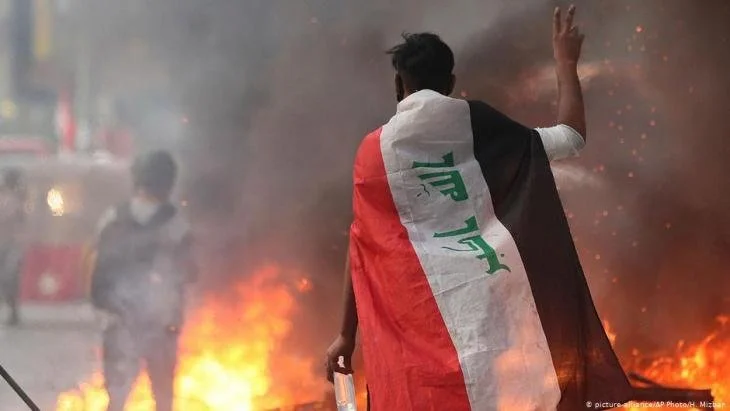
Protests in Baghdad, November 2019
The Power of the Protesters
I also met Hassan Alzenoun in the literary scene. Hassan, who was born in Damascus and arrived in Berlin four years ago, is a poet. He studied law at the University of Damascus and took part in the nonviolent protest of March 2011 in Syria. Since then he has written protest poetry that demands, among other things, the release of political prisoners from the regime’s prisons. He fled the country in the autumn of 2015, and since arriving in Berlin he has performed his poetry at festivals in Germany, Scandinavia and elsewhere.
Alzenoun sees the uniqueness of the Lebanese protest movement in the fact that for the first time, people of different sects and religions went out into the street as one, called on the leaders to end Lebanon’s sectarian regime, and demanded the government’s resignation. He argues that the protests empowered a people who until now were afraid to stand up to the Iranian hold on Lebanon. In his words, “In both Lebanon and Iraq, the protests express opposition to Iranian domination, and in both countries Iran does have armies or militias like Hezbollah that help resist all the revolutions.” He also mentions the widespread unemployment in both countries: about 35% in Iraq and about 40% in Lebanon.
Although she is rooting for these protests, Meis does not think the system of the established parties will disappear after years of demonstrations, because both countries have a complex history that is hard to shake off. One big change is that in recent weeks Iraqi women have also been joining the protests. She says Iraq is much more conservative toward women than Lebanon, which has always been more open and modern.
I asked her why the protest in Iraq was met with such great violence, compared with Lebanon. She replied that Iraq is a place with a great deal of violence in its past: ISIS, car bombs and various terrorists. “Iraq has only recently tried to recover from ISIS. People are still very suspicious of everyone and of everything that happens. It seems to me that if you lived under such brutal circumstances, you tend to be more violent. Of course, that’s no excuse for the behavior of the Iraqi police, but in my view it is one of the explanations.”
What is the new message of the Iraqi people in the new protest, after the liberation from ISIS?
“The Iraqi people are looking for security. Saddam Hussein has been gone for the last 17 years, ISIS is almost entirely gone, and people want change now. The new generation has no patience left. The war against ISIS was very significant in Iraq. But afterward, there was no desire to change the sectarian system and fully rebuild the country. Neither the defeated side nor the victorious side wanted to create a new structure, and after the victory, citizens realized that government corruption had not decreased and remained at high levels. Through the protests, the Iraqi people express a lack of trust in the political system. Iraq has money, resources, and people who received a good education, and the protesters want to bring about a better future. People no longer care whether the government is Sunni, Shiite or Kurdish. They want a functioning government first of all. People in Iraq don’t even have full access to water and electricity. And as I already said, Iraq is one of the richest countries in the world in oil resources. So this is simply unacceptable.”
N. sees great creativity in the revolution in Lebanon, with its savvy use of media and social networks. She argues that the level of state institutional violence is lower in Lebanon. “The revolution in Iraq is very political and very unique because there are so many young people in the streets. In Iraq, as in Lebanon, different ethnic and religious groups are cooperating, so there is a hybrid, mixed character that cuts across the protesters’ social loyalties, and at the same time the protesters are very young. In Baghdad they understood how to take over urban space, as was done in Tahrir Square in Cairo, which is a very strategic point that gives them visibility.”
What about the media coverage of the two protests?
“In the West there is caution toward both protests. They are seen as having potential for change, but there is still no optimistic news coverage like what we saw in the Arab Spring.”
“In Lebanon there is very high and extensive coverage compared with Baghdad. That is of course also related to the much greater presence of foreign media in Lebanon, and foreigners living in Lebanon can move from place to place relatively easily and safely. In Iraq there is no such level of security and freedom of movement for internationals from city to city. Another point is that Lebanese have a stronger diaspora, which includes many media networks, compared with the Iraqi diaspora. In the West there is caution toward both protests. They are seen as having potential for change, but there is still no optimistic news coverage like what we saw in the Arab Spring.”
“The reaction of the political establishment in Baghdad is very violent, very frightened. A high number of citizens have been killed in the protests in Iraq,” N. tells me, and adds: “In conversations with my Lebanese friends, including during my stay at a conference in Amman, it turns out that the trauma of Lebanon’s long civil war plays an important role here. The political establishment, the citizens and the different groups in Lebanon all know that any violent response could once again send the whole region back into civil war, and no one has a political interest in that. This awareness creates the possibility of changing the consciousness of the wider public at the demonstrations. But the government, too, has no interest in using violence against the wave of protest in Lebanon.”
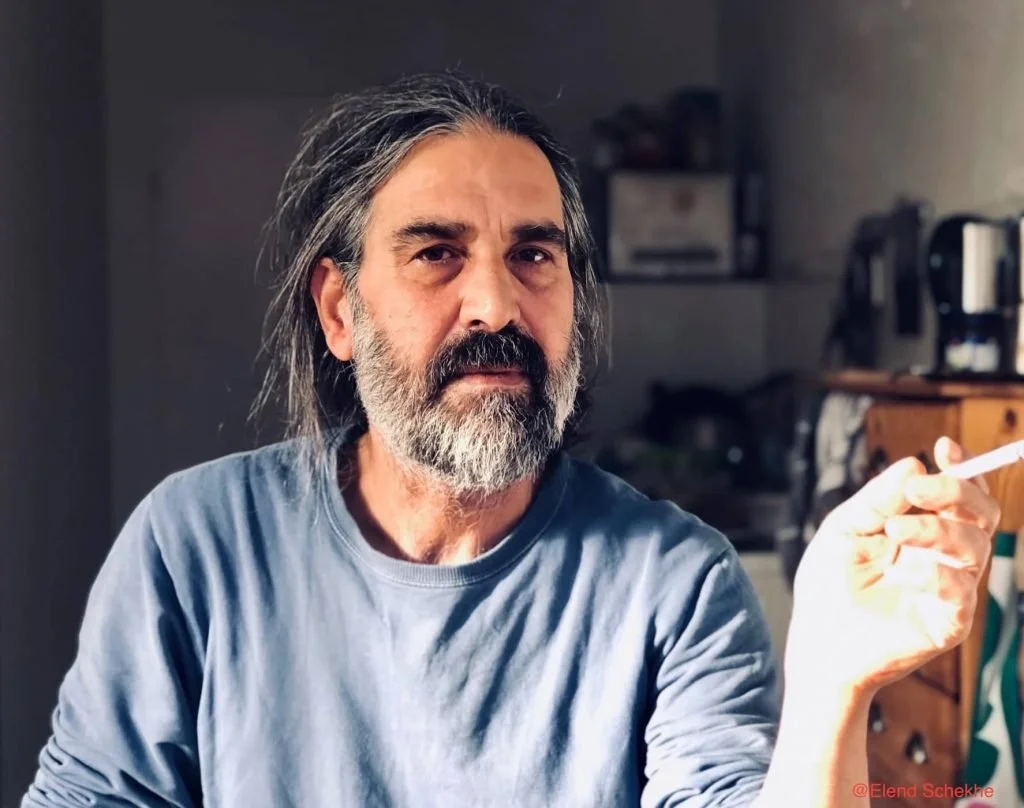
Abdulkader Mousa: “The protest needs to stay independent.”
Mousa agrees that ISIS is still there as a latent religious mentality among the majority of the people, so that liberation has not taken place in that respect. Militarily, ISIS lost its influence, but it is nevertheless present in certain places and regions. He offers a different explanation for the Lebanese regime’s lack of violence toward the protest. In his view, it is related to the different histories of the two countries. He points to the great diversity of ethnic and religious groups in Lebanon, its mental closeness to Europe (due to French colonialism), and the fact that Lebanon never had a dictatorial government like Iraq.
Hassan’s explanation for the different responses to the uprisings is that Hezbollah has had little success in suppressing the protests in Lebanon, unlike the Shiite militias in Iraq, which used their power to crush the protest. He is awed by the solidarity that erupted between Shiite and Sunni protesters in Lebanon.
The Arab Spring: Spot the Differences
Outgoing Prime Minister Hariri was involved in a scandal over an affair with a South African model. Meis says he “donated” 16 million dollars to the model, at a time when citizens are already furious about politicians’ corruption. I ask her whether it is possible to leap over the ethnic problems in Iraq and Lebanon, but she tells me that the question is wrong, because “these two countries are mostly Arab and independent in their region. Of course there are Kurds in Iraq or Maronites in Lebanon, but that is not the point of the protests. The ethnicity of both countries unites more than it divides. It doesn’t matter whether you are Shiite or Sunni, Jewish, Christian or of any other religion, because you are Arab. When you recognize the differences between all these religious groups, you don’t have to support separating them. It is more about the respect that should be given to each group’s different history, despite the common denominator of Arab ethnicity. Maybe we need to look more for what we share than for what divides us, but it is also important to respect difference. One of my favorite sayings is: ‘Either you are a brother in your faith, or you are equal in your humanity.’”
N. believes these protest movements bring a new message to the region, and that it is too early at this stage to know what it is. Still, in her opinion, the message definitely includes a new national imagination. “It is clear that the new generation has understood that sectarian separation keeps the state from reaching a better future. The protests are shaking the sectarian structure of the political system that rules Iraq and Lebanon.” Mousa, by contrast, is pessimistic about the future. In his view, the two revolutions will not succeed in ending ethnic separation in the short term and will not be able to leap out of it. He says the central goal of both revolutions must be to guarantee the rights of the different ethnic and religious groups constitutionally.
Iranian Involvement
As noted, the protest in Iraq and Lebanon is also directed against Iran’s external interference in their affairs. I ask Meis about Iran’s intervention, since Iran of course wants to gain greater control in both Lebanon and Iraq. She asks me to turn the question around: “Don’t the Shiites in Lebanon and Iraq also support Iranian politics, at least its foreign policy? Take Yemen or Syria, for example. The connection between these countries is also a religious one. For example, in Muharram, the first month of the Muslim calendar, which is an important month for Shiites, millions of Lebanese and Iranians visit Iraq. Many Iraqis visit Mashhad, which is very holy to them. To understand the connections between these three countries, you have to look at the religious ties between them. Of course Iran has foreign policy interests in Iraq and Lebanon, which people are rising up against, but Iraq and Lebanon also have interests in Iranian politics, and they support Iran’s policy in Syria, for example.”
“There is a new generation in the Arab world, aware of its political power and of the drama unfolding in the region. They understand that going out into the streets is a tool for changing the existing situation.”
According to N., “Iran’s intervention in Lebanon is not like its intervention in Iraq. In my view, the protest taking place in Khartoum, Sudan, and in Algeria should be included together with Iraq and Lebanon, because in all four countries there is a mass movement for change that began in the Arab Spring of 2011-2012. We now have a new generation in the Arab world, aware of its political power and of the drama unfolding across the whole region. They understand that going out into the streets is a powerful tool for changing the existing situation. In Sudan we already see the partial success of the protest movement, in Algeria perhaps less, and in Iraq the prime minister resigned. This is a public movement for comprehensive social revolution in the Arab world.”
N. notes that Iranian intervention sits alongside the intervention of other countries, such as Saudi Arabia, in Lebanon and Iraq: conservative forces that do not want to see democratic, civil change in the two countries. Mousa points out that since Iran has a Shiite leadership and Turkey, under Sunni leadership, is trying to rebuild the Ottoman Empire, both are trying to defeat Israel as a strong partner in the Middle East and to fight it as an enemy.
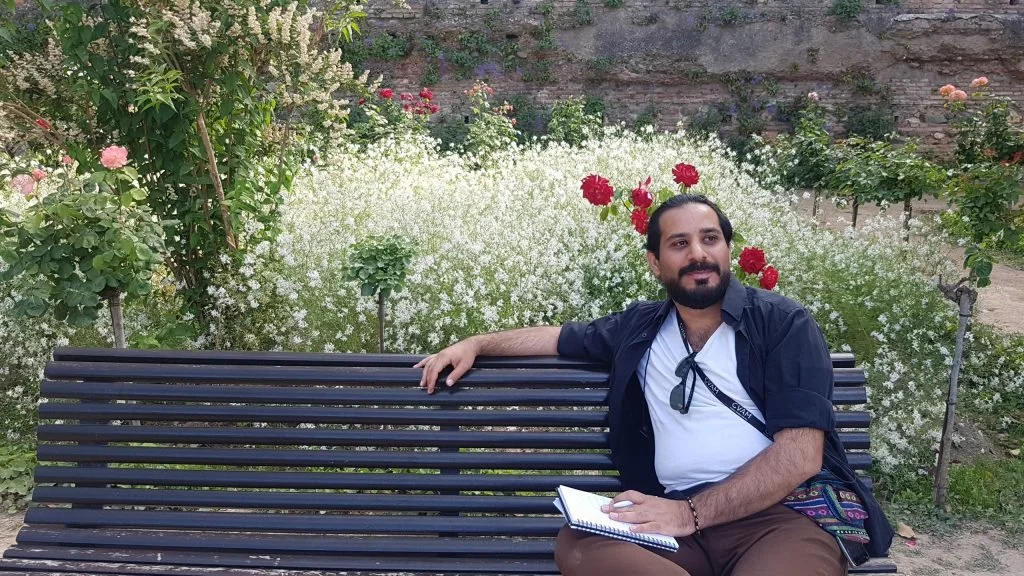
Hassan Alzenoun in Berlin: “The Lebanese benefit from the experiences and mistakes made in previous years by others.”
According to Hassan, the central message of the Iraqi people today is that the sectarian system that has ruled the country since the Iranian intervention must end. The protesters understand Iran’s interests and recognize the destructive power of corruption. Corruption has deepened the impoverishment of the entire Iraqi people, except for a minority of cronies. The government’s failure to provide basic services such as schools and hospitals has led the Iraqi people to abandon the separate categories of Sunni and Shiite and to go out together into the streets to demand an end to corruption and to rescue Iraq from the crisis.
The Arab Spring, in Hassan’s view, broke the stagnation and tyranny that prevailed in all the countries where uprisings took place. That includes those where the popular movements achieved their goals, at least to some extent, like Tunisia, and even those where excessive force was used, causing displacement, destruction and chemical weapons (as in Syria). “The Lebanese people copied the spirit of the Arab Spring, but in a different way,” he says. “The Lebanese benefit from the experiences and mistakes made in previous years by others. Their message is that the people cannot be defeated, and that freedom will reign long after the dictators and their regimes have passed from the world.”
Berlin as a Laboratory for Possible Change in the Middle East
I can’t finish without asking Meis about Berlin. She loves the city because both identities, Arab and German, can live in it happily. Berlin is the only city in Germany where she can think of herself as completely Arab and German, and no one can take that from her. “Berlin is multicultural, and the religious divide here is not felt the way it is in the Middle East. You can see Palestinians, Lebanese, Iraqis, Syrians and so on identifying first of all as Arabs, with religious affiliation coming only afterward.” But still, she says, “you would have to be naive to think that the peace we experience here among everyone in Berlin can be transferred to the Middle East. Berlin is like a pleasant bubble where everyone can be who they want to be, and most people have no problem with that, but in the Middle East we have completely different starting points. So Berlin doesn’t change my point of view, but it gives me hope.”
“Berlin is like a pleasant bubble where everyone can be who they want to be, and most people have no problem with that, but in the Middle East we have completely different starting points.”
N. smiles when I ask her about Berlin, and tells me the city gave her an amazing opportunity to meet Arabs from all over the Arab world, whom she could not have met in the Middle East. “There is a very creative exile community here of artists, musicians, writers and fascinating people. People come for different reasons, from all over the Middle East, and make up Berlin’s special story. This diversity inspires me. I’m interested in hearing the story of their exile, their migration and their journey.”
According to Mousa as well, living in Berlin, a large metropolis that contains many ethnic, cultural and religious groups, is an enriching and instructive experience. “In terms of structure and management, Berlin can be a good model for large cities in the Middle East,” he says, “but not under national thinking. That means the Middle East needs a reorganization that crosses the national borders of the states.”
Hassan wrote me moving words, with which I agree, and I sign on to every one of them. “For me, Berlin is a city that makes the world smaller: within it you can find people of all the religions of this world. Muslims, Jews, Christians, as well as agnostics and atheists. It is a wonderful example of peaceful multicultural coexistence among peoples. But above all, Berlin gave me the freedom that was stolen from me in the Middle East, and more than that, an endless sky on whose clouds I can write my poems.”
May words of peace and pluralism one day come upon all the inhabitants of the Middle East.
Mati Shemoelof’s bilingual book “Baghdad | Haifa | Berlin” has just been published in Germany.
First published on Haokets Magazine, 2 January 2020
Category - Articles and Essays
Tags: Mati Shemoelof, Freedom Will Reign After the Tyrants, Berlin, Middle East, Arab Spring, Iraq, Lebanon, Syria, Palestine, Jordan, Refugees, Exile, Arab Diaspora, Arab Protests, Iraqi Protests, Lebanese Protests, Iranian Influence, Political Change, Democracy, Sectarianism, National Identity, Migration, Multiculturalism, Berlin Exile Community, Rojava, Syrian Kurdistan, Hassan Alzenoun, Abdulkader Mousa, Meis Alkhafaji, Political Interviews, Baghdad Haifa Berlin
Related Links:
From Berlin with Hope: The Dream of a Middle East Union