Why writing and speaking Hebrew in Berlin matters now more than ever
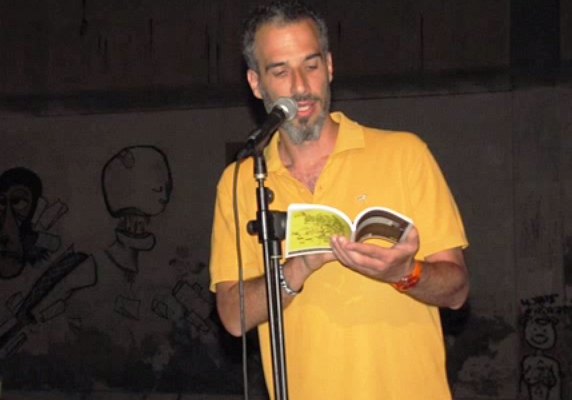
As Nazi-era terms such as 'Heimat' (homeland) and 'Volk' (the people) return to the mainstream discourse, it is increasingly important to resist the notion of one language for one people from movements who dream of a purity of race and culture
Mati Shemoelof
I recently met a friend, a Berlin expat, who was revisiting his hometown after moving to Paris a few years ago. He has a good job there managing a cultural institution, has learned the language and, to some extent, has integrated into the French cultural world without relinquishing his Jewish and Hebrew roots and Diasporic worldview.
As we sat at a Kreuzberg café, the conversation drifted to the differences between Berlin and other cities when it comes to cultural identity as artists. He said that Paris demanded complete cultural and linguistic assimilation, with all that this entails. But Berlin, his former place of residence, does not require such a process. Berlin allows him, as a Yiddish activist and Diasporic intellectual, to preserve the variety of identities that are already part of him as well as new ones he wishes to explore.
He pointed out that in Paris, for instance, I would not have been able to co-produce and co-curate my "Poetic Hafla" evenings – an artistic group that creates multilingual literary events and performances in Berlin without translation. In Paris, he explained, they would have told me to start by learning the language, since in Paris you can only perform in French.
The demand for full assimilation has always scared me. I've never had a talent for mastering other languages and my writing talent has been my saving grace, allowing me to invent my own syntax in different forms of the art of writing. When I emigrated to Berlin, I knew that I wouldn't abandon my beloved Hebrew language, and in 2019 I published my first bilingual poetry book, "Baghdad | Haifa | Berlin." It was one of the first books published after the Holocaust to be written by a non-Ashkenazi Hebrew writer living in Berlin.
I've often wondered what would have happened if I'd switched to writing in "broken" German, like the Galilee-born author Tomer Gardi, or even broken English. I experimented with the bilingual poetry and a radio play that I wrote in English was translated into German. But I love the Hebrew language, where every word can date as far back as the ancient times.
I've thought a lot about what my Parisian friend told me. Berlin allows me to live in-between languages, in-between worlds, without asking for full assimilation or full integration. It receives me openly with my broken German, my broken English and even my strange Hebrew – which also changes and accepts into it the other two languages (English and German) that accompany me.
Dreaming in Hebrew
Writing Hebrew in Berlin is not a standard category such as writing English, French or Arabic in Berlin. Hebrew has an entirely different tradition here. In between the two world wars Berlin embraced a rich Hebrew literary center, with publishing houses, magazines and many Hebrew writers who lived in Berlin while dreaming in Hebrew. Some of these writers were Zionists, others were from the Bund Socialist party, and there were also communists, liberals, anarchists and others. After World War II, this rich Hebrew literary scene was erased from the face of the earth and to this day there is not a single Hebrew publishing house in Berlin.
With the arrival of tens of thousands of migrating Israelis to Berlin over the past 15 or so years, however, Hebrew returned to the city's sidewalks. Writers, poets, musicians, artists and others create their works in Hebrew – often combined with German and English, as well as other languages. It is hard to ignore the fact that Hebrew is now part of life here.
Hebrew also has its own unique cultural system, which is also connected to the city's historical past. Slang, for instance, is constantly being recreated in Berlin. As a language within Hebrew, this slang symbolizes the unique cultural and linguistic space of Hebrew speakers in the German capital.
Let's look at a few examples. There is a bar in Berlin called Südblock (meaning "Southern Block" in German). A Jewish friend of mine started calling it "Jydblock," replacing the German "süd" with "Jyd," which in many Slavic languages means Jew – often in a derogatory manner. This is one way in which new slang is being created while referencing the Jewish past but also the present, and in doing so is unique to the place and community that uses it.
Another fascinating example is the slang word "todanke," which comes from "toda" in Hebrew and "danke" in German (both meaning "thank you"). Thus, in Berlin, a local Hebrew is created with and between languages. It is unique to the place, but also to its users.
This new invented Hebrew dialect / language has a strong correlation Hebrew, but also with the place in which it is spoken and the German language. One could claim that Jews who emigrated back to the Diaspora are returning to the former situation in which many Jews lived, and are now using three languages: German, a local language (Yiddish or slang, Berlin's English, and/or the combination of those three) and Hebrew. The national monolingual norm is being abandoned and there is a return to multilingualism.
Borrowing a well-known term from the French scholars Deleuze and Guattari, writing Hebrew in Berlin is a turn toward a "minor literature." A Hebrew writer can play with the German language of Berlin and even write a German novel, but he or she will always be perceived as an outsider, one who enters the temple in disguise. In addition, abandoning writing in Hebrew can come at the price of potentially alienating one's readership in Israel.
With that said, I do not think German culture should be solely defined by the German language. Those who live in a place acquire knowledge of and experience the local climate, architecture, festivals, clubs, streets, holidays, television, cinema, leisure, and so on. There are many things that grant them access to the local culture, and their presence is also part of that culture.
In 2017, I took part in a special conference at the Literary Colloquium Berlin, where we discussed expat writers creating in different languages in the heart of the German capital. No one has ever taken up the mission of recreating the Hebrew center as it was between the two world wars. Perhaps there is no need for one. Maybe there is just no real linguistic, cultural or political person to lead the Hebrew community of Berlin.
This unfortunate fact may also be related to the lack of knowledge and direction of this community.
An Israeli playwright recently came to Berlin and asked me where the Hebrew community resides. I smiled and replied that there is no such thing – everyone is scattered in many neighborhoods and there is not one specific place you can point to as a Hebrew center.
There is, however, one journal: Mikan Ve'eylakh: Journal for Diasporic Hebrew, and an online magazine in Hebrew called Spitz (a name that has parallel meanings in both German and Hebrew). Beyond that, the local municipality recently established an annual award of seven scholarships for non-German writers in Berlin. Sometimes one of these winners is Jewish or Israeli, but there isn't any specific literary scholarship for Hebrew writing in Berlin.
Since there aren't any Hebrew publishers in Berlin either, Hebrew writers are left without any real Hebrew publishing industry to help them grow. Some, like the poets Zehava Khalfa and Hilà Lahav, or the novelist Hila Amit, are publishing their books in Israel. But no one knows their work in Germany.
A return to 'Heimat'
The far right in Germany has been gaining strength over the past decade. Alongside its reemergence in the mainstream, the perception of loaded, Nazi-era terms in German political culture such as Heimat ("homeland") and Volk ("the people"), as well as the attitude toward the German language, are intensified (often in response to what the far right perceives as the threat of Muslim refugees and others coming to Germany).
This image of some imaginary homeland occupied by white "Germans" who speak only German – a language they perceive themselves to be the owners of – becomes clear through the resurgence of the concepts of Heimat and Volk in the German discourse. Less extremist parties are already embracing the use of Heimat without recognizing the dangers involved.
Recently, a collection of Hebrew poetry in Germany, "Was es bedeuten soll. Neue hebräische Dichtung in Deutschland" ("What is that supposed to mean. New Hebrew poetry in Germany," edited by Adrian Kasnitz and Gundula Schiffer), was published by a small publishing house in Cologne. But what is the meaning of writing Hebrew poetry in Germany while far-right parties are poisoning the atmosphere? Is it the same as living in the more pluralistic, Ausländer-welcoming city of Berlin?
I think the answer is no. Berlin does not represent the rest of Germany, and writing Hebrew in Berlin is not the same as writing Hebrew in Germany. It is not by accident that most of the writers of that abovementioned anthology were based in Berlin.
The Alternative for Germany (AfD) party fights to be portrayed as philosemitic by waving Israeli flags at its demonstrations – as if to say "I'm chasing the Muslim refugees out of Germany and not the Jews." But the truth is that there are plenty of antisemites and neo-Nazis in the AfD.
Can the German far right tolerate the existence of non-German-speaking foreigners, who instead of mastering German as an exclusive language speak a mix of a little German, a little English and a lot of Hebrew? Will the multiplicity of languages not create anxiety in those who dream of a purity of race, culture and language?
A few years ago, I participated in a Jewish panel at the legendary Berliner Ensemble theater to mark International Holocaust Remembrance Day. The moderator made jokes about us all being Jews. He wasn't alone, but in the middle of the discussion I realized that I could no longer accept this humorous tone and switched the conversation to a more serious one.
I noted that if the AfD comes to power, it will not ask if I'm an Arab or a Jew, but will identify me through my Middle Eastern appearance and broken German – and it will not take long for me to suffer the consequences of being defined as the enemy. From my perspective, a hate toward the Other that elicits Islamophobia should not be ignored by those who constantly fear the rise of antisemitism in Germany on the pretext that it is not antisemitism. As I see it, there is no Islamophobia that does not ultimately also lead to antisemitism.
What does writing in Hebrew have to do with far-right movements? Well, it is directly opposing the monoculture of the right-wingers who wish – in Germany as well as in other parts of the world – to have one language for one people in one land. Hebrew writing in Berlin, as well as writing in other foreign languages, is in direct opposition to the idea of total assimilation, since it promotes a Berlin with a revived, new hybrid and lingual syntax.
When a person arrives in a city and refuses to write in the language of that place but instead chooses to preserve their own language – an ancient language which belonged to a community that became extinct in that city – it is both an act of rebellion and an attempt at healing.
Therefore, the call to produce a Hebrew literary scene must come from the German literary establishment in Berlin, not only as support for the existing culture but as an act of encouragement to rebel against assimilation – which could mean the eradication of Hebrew from the city for a second time.
I grew up in Israel, where my mother tongue as a Baghdadi Jew from Iraq was extinguished in order to create a monolingual, monocultural society. That is why I am cut off from my mother's language and the only language I have is modern Hebrew. There are many other residents of Berlin who write in their original language while at the same time maintaining a dialogue with the local society and German culture.
The rejection of the idea of "one place, one language" is both cultural and political. What we need is a society that rejects the concepts of integration and assimilation as the only option to enter its gates.
That is also true of the special culture of Berlin in the Jewish context, where one Hebrew literary center has been erased and another is currently rising – but also in regard to the multicultural context of Berlin, where a multiplicity of cultures can communicate using English or German while creating a new syncretism: a hybrid language where the meeting points of different cultures create a new element we did not have before. While this element is by no means a new power capable of tackling the racist notion of Heimat, it does create spaces in which it is irrelevant and brought out of the shadows.
Earlier versions of this article were published in "Mantis: A Journal of Poetry, Criticism, and Translation" issue 19 (2021) and "Stadtsprachen" magazine, issue 24 (2023). This version was published on Haaretz.com
Mati Shemoelof is a poet and writer. His second poetry book in Germany, "Das kleine Boot in meiner Hand nenn ich Narbe: Gedichte" (Parasitenpresse), is published this month. Visit his website for more details: https://mati-s.com/
Focus Keyphrase
Secondary Keywords
Hebrew literature in Berlin
Hebrew writers in Germany
Jewish culture in Berlin
Multilingual literature
Jewish diaspora
Language and identity
Mati Shemoelof
Links
Berlin's Hebrew literary history
ANU – Jews and Arabs Writing in Berlin
multilingual literary community in Berlin
essays on Jewish identity and diaspora
Mati Shemoelof, Berlin-based writer
Tags
Hebrew Literature
Berlin
Jewish Diaspora
Multilingualism
Language and Identity
Jewish Culture
German Literature
Cultural Assimilation
Mati Shemoelof